
MAKING AN ENTRANCE: THE POWER OF A GOOD HALLWAY
The Hallway as a Room in Its Own Right
Most people design every room in a house before they think about the one connecting all of them. Hallways, stairwells and landings tend to be treated as circulation rather than space, which is a mistake we see repeated across even the most carefully considered homes. Given proper attention, they set the tone for everything that follows.
Storage that disappears into use
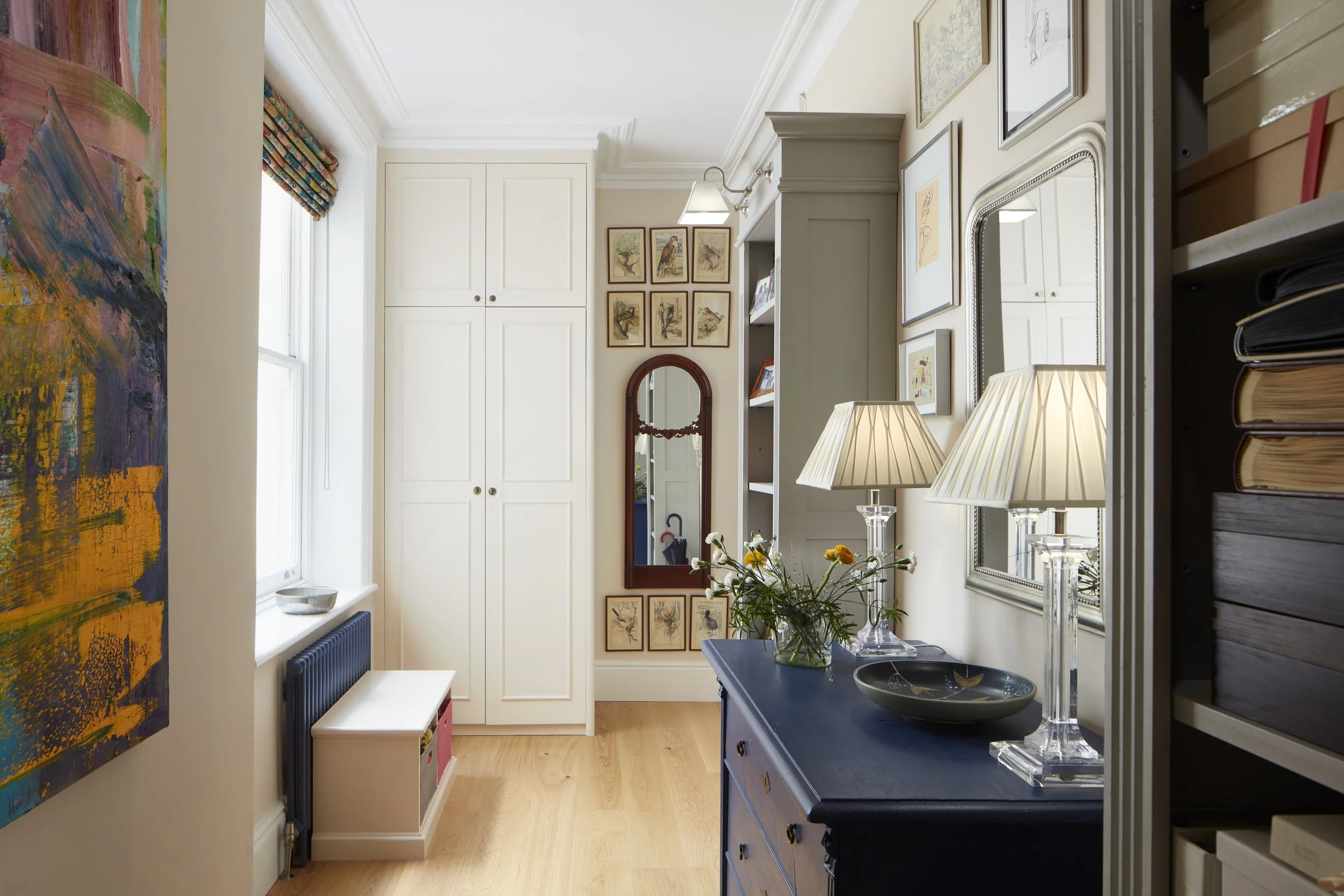
Because a hallway is rarely wide, storage has to be slim by necessity rather than by style. A narrow console with drawers, a mirror above it, does most of the work: somewhere for keys and post, and a sense of openness the mirror adds almost incidentally. We have used USM's modular storage for nearly two decades for exactly this reason. It holds its shape and its usefulness across very different projects.
Beyond the console, the same principle holds. A tall, narrow cabinet absorbs shoes and umbrellas without crowding a passage. A single long, slim shelf can conceal a radiator and still offer somewhere to place things. None of this needs to announce itself. The best hallway storage is the kind a visitor never notices.


Giving everyday objects a fixed home
Clutter tends to appear wherever an object doesn't have an assigned place. A lidded box or tray on a console holds keys and change; a slim letter rack keeps post from spreading across a surface. Where the width allows, a shallow chest of drawers or a slimline bookcase earns its place, and a basket on the floor does the same for shoes and seasonal items, in woven rattan for warmth, metal for something sharper, timber for something that reads as furniture rather than storage.
In households with more daily traffic, a dedicated zone near the door for hooks, a shelf for keys, a basket for bags, keeps the morning rush from becoming a search. Where cables and devices are part of daily life, a concealed charging point built into that same zone removes one more thing from the counter.


Building storage into the architecture
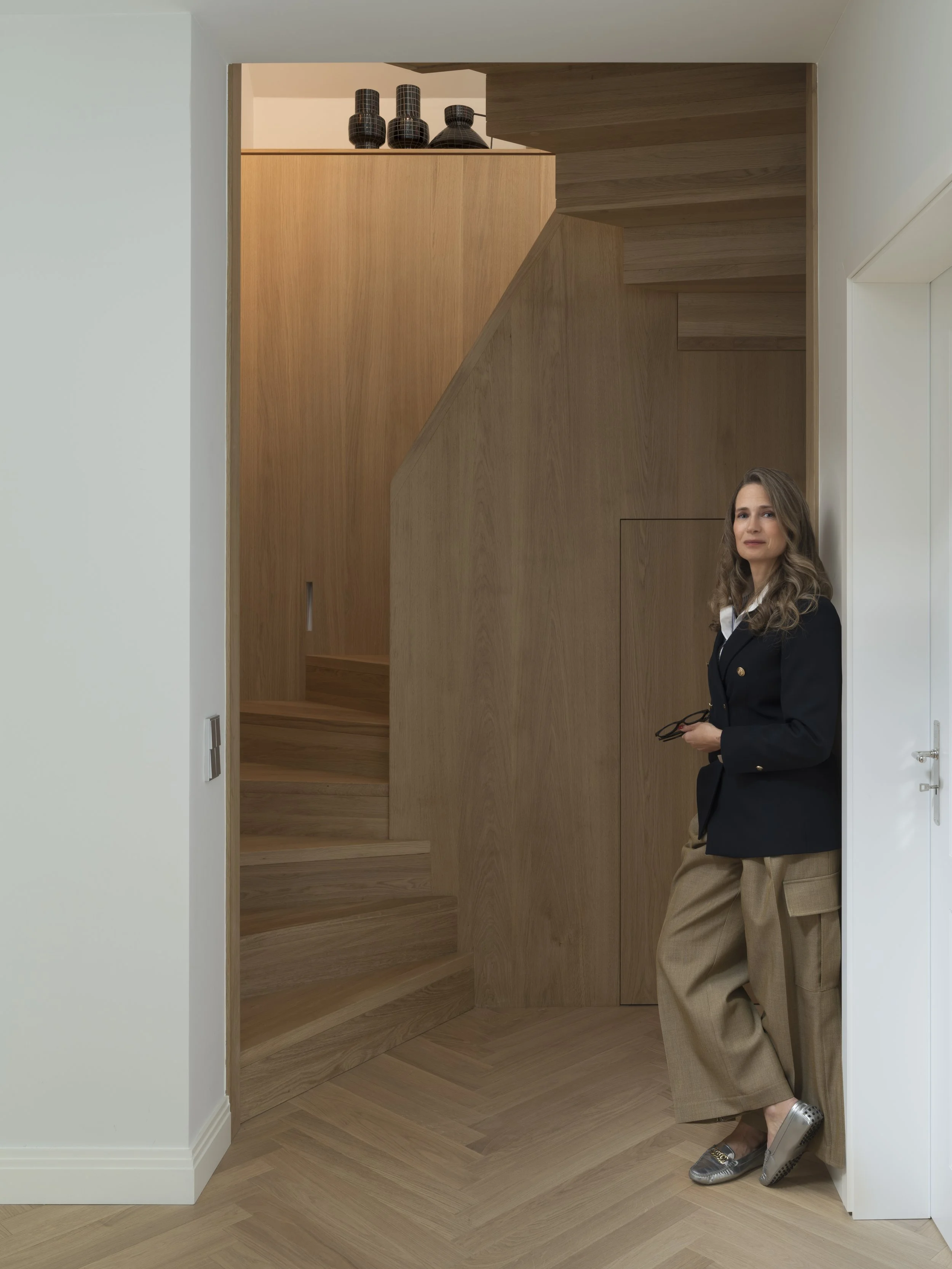
Where floor space is limited, height becomes the resource worth using. Floating shelves lift display space off the ground without adding bulk. Where a hallway can be structurally reconfigured, fitted joinery run to ceiling height, paired with a lower unit that doubles as a room divider, does more for a narrow space than almost anything else. We have done this in our own house.
The most successful version of this kind of joinery is painted to match the surrounding walls, so the storage recedes rather than announces itself. Even a narrow bookshelf or a vertical row of hooks can turn an unused wall into something that works. A tiered coat rack, where there's room for one, adds both storage and a bit of visual rhythm to a corner that would otherwise go unnoticed.
Seating, where it earns its place
A small bench with storage beneath solves two problems at once, somewhere to sit while removing shoes, somewhere to keep them once removed. Upholstered benches soften what is often a hard-edged part of the house. In one project, bespoke metal furniture with AFD gave us storage in an ultra-slim footprint, without narrowing the circulation space around it. Where a full bench doesn't suit the proportions, a slim wall-mounted seat or a small stool does similar work at a smaller scale.
Keeping the sightline open
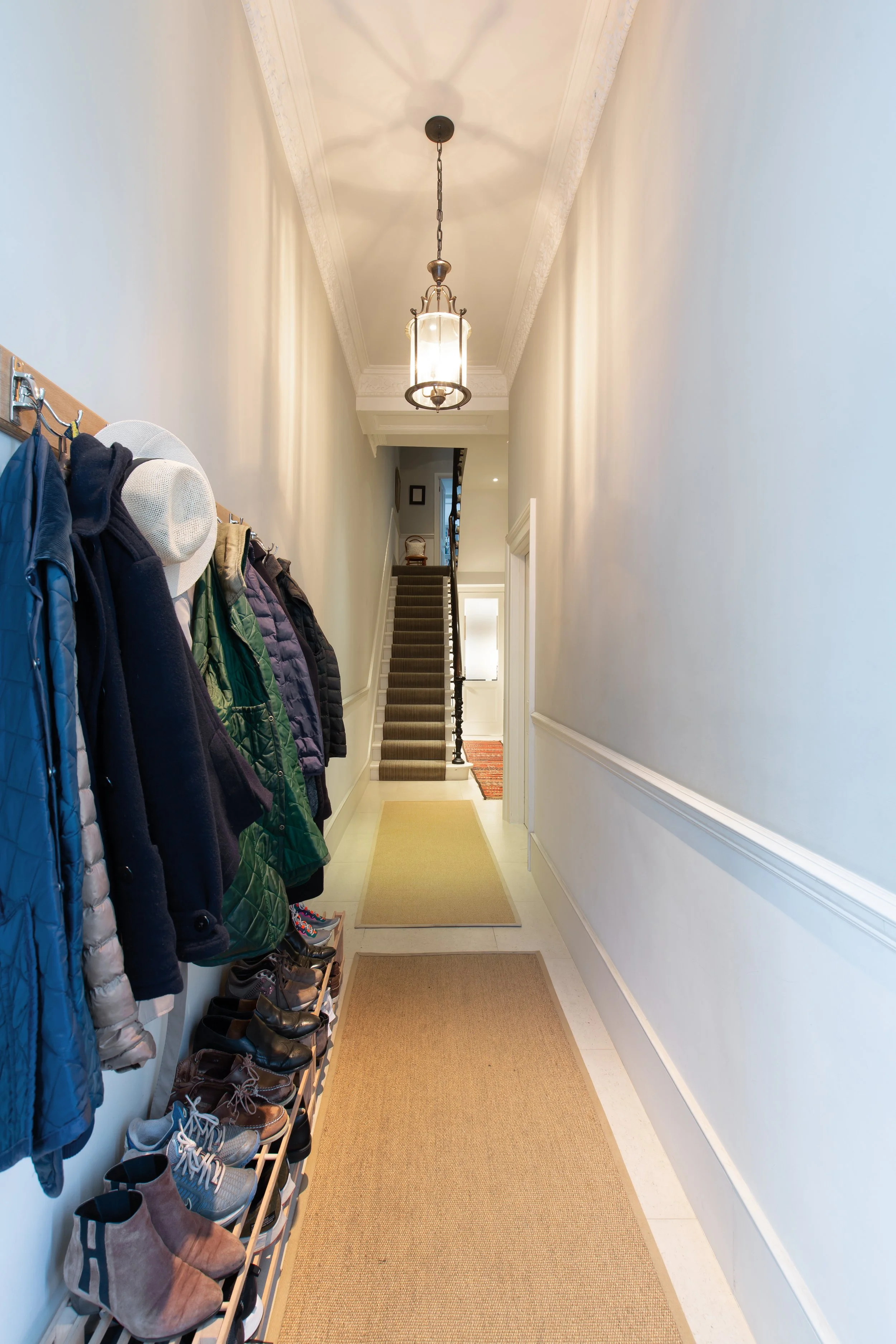
In a narrow hallway, what stays off the floor matters as much as what's stored. Wall-mounted consoles and floating shoe racks keep the space feeling open rather than hemmed in. Where there's genuinely no depth to spare, a row of hooks does the same job. We often turn to Porada's slim wall-hung storage boxes here, which function as both storage and a considered decorative object.


Curating rather than decorating
A hallway rewards the same editorial thinking as any other room. Family photographs, a small collection of books or ceramics, bring warmth, but they need editing as carefully as anywhere else in the house. On a longer stretch, a gallery wall above shallow shelving can carry real presence, whether the framing is deliberately mismatched or kept uniform. Floating shelves layered with a handful of objects do the same at a smaller scale. What matters is restraint, not absence: a hallway with too little says nothing about the people who live there, and one with too much says the wrong thing.
When the hallway becomes a room
Where proportions allow, a hallway can hold more than passage. We have converted wide landings into small reading libraries, with fitted shelving and a single chair placed under a skylight. In another project, a client's love of music became a piano nook, with acoustic wall panels that doubled as both practice space and design feature. We have also built slim home-working stations with concealed power, gallery corridors for a family's art collection, and in larger properties, drinks stations and wine storage in wide entrance halls. The right use of the space follows how the household actually lives, not a fixed template.
Changing the architecture itself
Sometimes the more effective intervention isn't storage at all, but the layout underneath it. Period properties in particular tend to carry redundant doors and awkward recesses, remnants of how the house was originally used. In one Victorian house, we found a reception room with two entrances, a leftover from service-era circulation. Closing one gave us room for a full-height storage unit disguised as an antique wardrobe. In another, removing an unnecessary corridor and relocating a doorway turned a dim passage into a proper entrance hall.
These changes don't always require major construction. Widening a doorway, adding a glazed partition to borrow light, inserting a pocket door to reclaim floor area, all can shift how a hallway functions without touching its bones. There is usually a trade-off, a different traffic pattern, a lost secondary door, but where circulation is taking up disproportionate space, the benefit tends to outweigh it.
What keeps it working
No amount of good design holds a hallway in order without small daily habits behind it. Shoes back in their basket, keys on their hook, post into its tray: five minutes at the end of the day is usually enough. It works best when the whole household understands where things belong, rather than relying on one person to keep resetting the space.
A hallway that stays in order tends to say something about how the rest of the house is run. It is easy to overlook precisely because it asks so little, right up until it stops working


Do you have a project in mind or require help with designing hallways in your home?