
Designing a Staircase Like a Room
A staircase is, on average, the most used architectural feature in a house. People walk through it many times a day, every day, for years. It is the spine of the building — the place where the floors connect, the route the family takes between sleeping and waking, between morning and evening, between the rituals of each part of the home.
And yet, of all the architectural elements in a typical house, the staircase is the one most likely to be treated as a passage rather than a room. The kitchen gets the attention. The living room is debated for months. The staircase, all too often, is left as it was when the family moved in — carpeted in something neutral, painted in the same colour as the walls, lit by a single overhead spot, fundamentally invisible.
This is a missed opportunity. The staircase is the only piece of architecture in a home that you move through rather than dwell in — and that means it can be designed as a continuous, unfolding experience. The colour, the light, the material, the rhythm of the treads, the view from the half-landing — all of these are part of a sequence the family will register daily. Treated thoughtfully, the staircase becomes one of the most quietly transformative elements in a home. Treated as an afterthought, it becomes a silent flaw running through the centre of the building.
I have come to think of staircases as rooms in their own right — vertical rooms, but rooms nonetheless. They deserve the same intention, the same material thought, the same consideration of light, scale, and detail. The moments I most enjoy designing are not always the kitchens or the living rooms. They are the moments of architecture between rooms, where the building changes register and where the family's experience of the house is shaped quietly and continuously.
The stair as sculpture
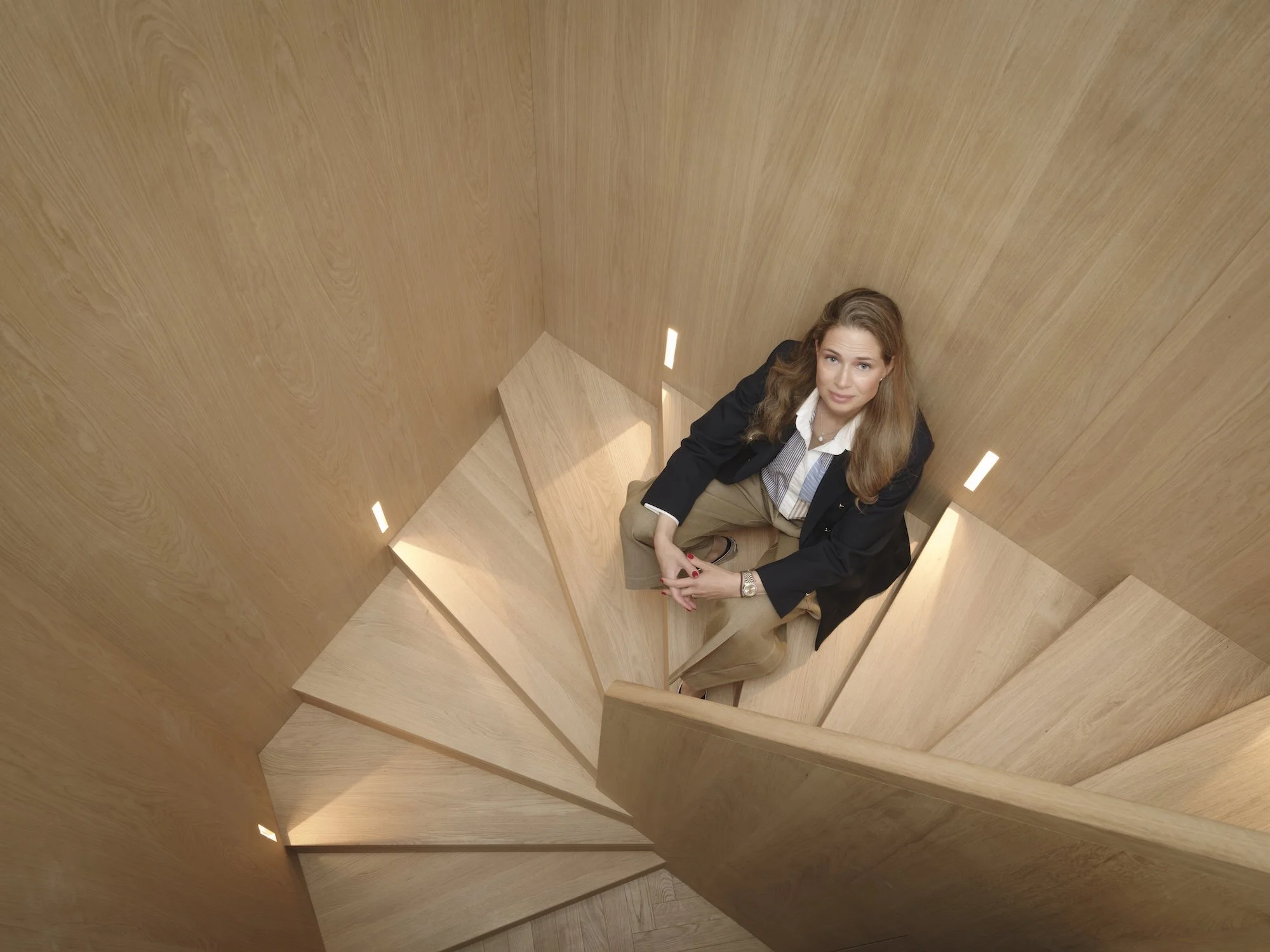
A staircase can be a piece of sculpture as much as a piece of architecture. The shape of the run, the geometry of the treads, the material of the strings, the way the form occupies the volume of the stairwell — all of these can be designed for with as much intention as any chair or table elsewhere in the home.
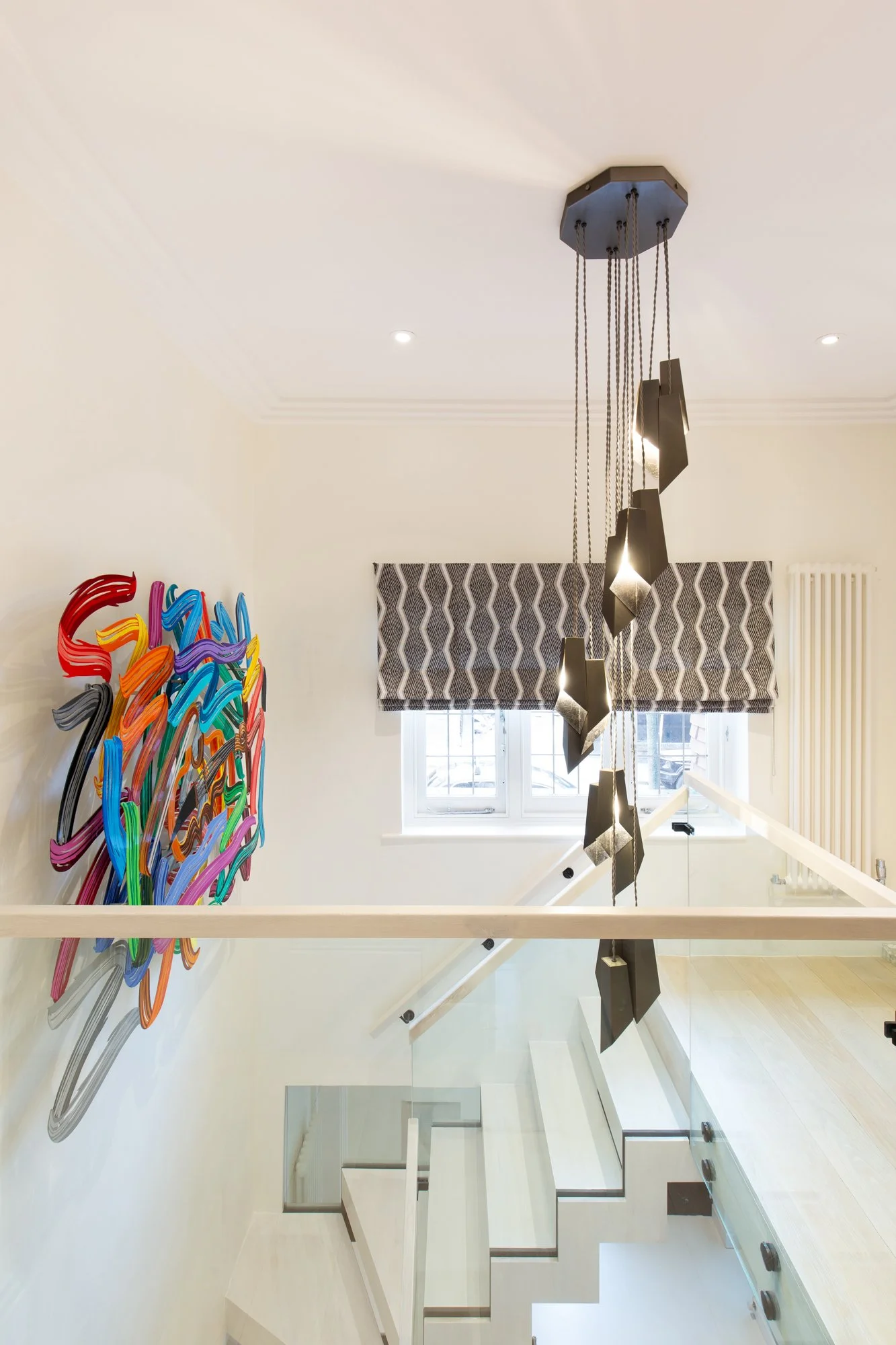
In one project we removed the walls around an existing staircase entirely and replaced the standard run with a free-floating spine staircase that rises through a new double-height void. Commissioned feature artworks line the upper wall, drawing the eye up the height of the building. The staircase is now the room's only architecture — the route, the focal point, and the spatial drama all in one. Visitors arriving for the first time stop at the door and look up, rather than ahead.
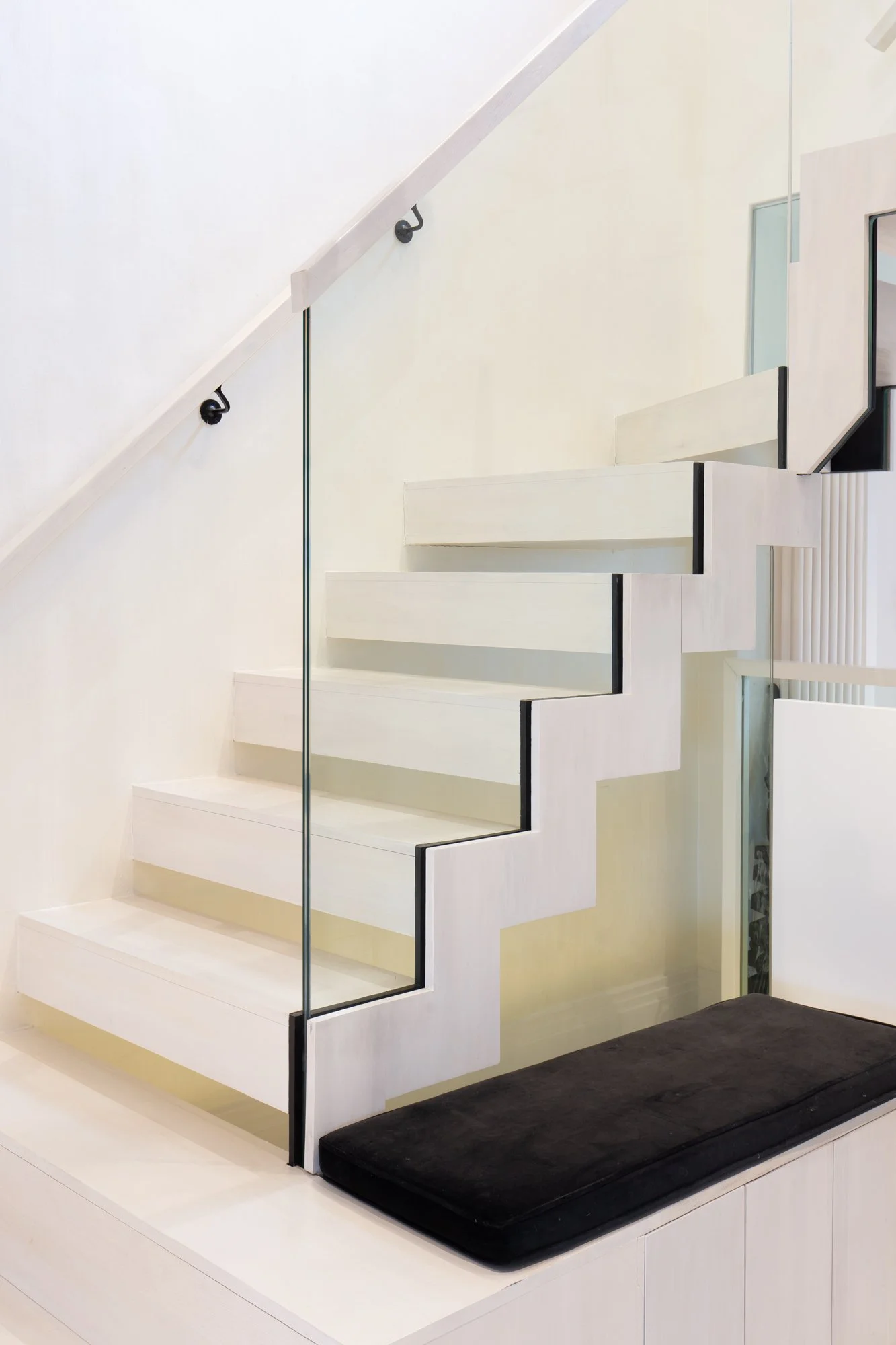
In another, we stripped out a tired oak stair and replaced it entirely with a cantilevered zigzag design — steel strings beneath, white wood treads above, glass panels along the side. The staircase appears to hang in the air, light moving through it rather than around it. The room beneath, which had previously been swallowed by the bulk of the old stair, now reads as continuous with the floor above. The intervention is dramatic, but the result is calmer rather than busier. The building feels lighter than it did before.
A floating stair, a cantilevered run, a sweeping curve, a sculptural zigzag — these are rarely the cheapest option. They almost always require structural engineering and bespoke fabrication, and the planning sits firmly in the architectural rather than the decorative end of a project. But the impact, on every other decision in the house, is decisive. A bold staircase changes how the building is read.

The staircase as a canvas
The vertical walls of a stairwell are some of the largest, most continuous, most underused surfaces in a typical house. Most are painted in a neutral and left alone. This is one of the more surprising omissions in interior design, because a staircase wall is — by virtue of its height and its visibility — one of the most opportunity-rich surfaces in the home.
In one project, the client's signature brand colour ran as a continuous runner stripe through the centre of the house, up and across the staircase, threading the rooms together with a single tonal thread. On the staircase walls themselves, we measured and painted a set of bold black-and-white stripes, calibrating each band to the rhythm of the stair so the pattern resolved cleanly at the landing rather than running off the edge. The result was a stairwell that read as a piece of architecture and a piece of graphic design at the same time — a daily experience of colour and rhythm that the family moves through without ever quite registering as separate from the building.
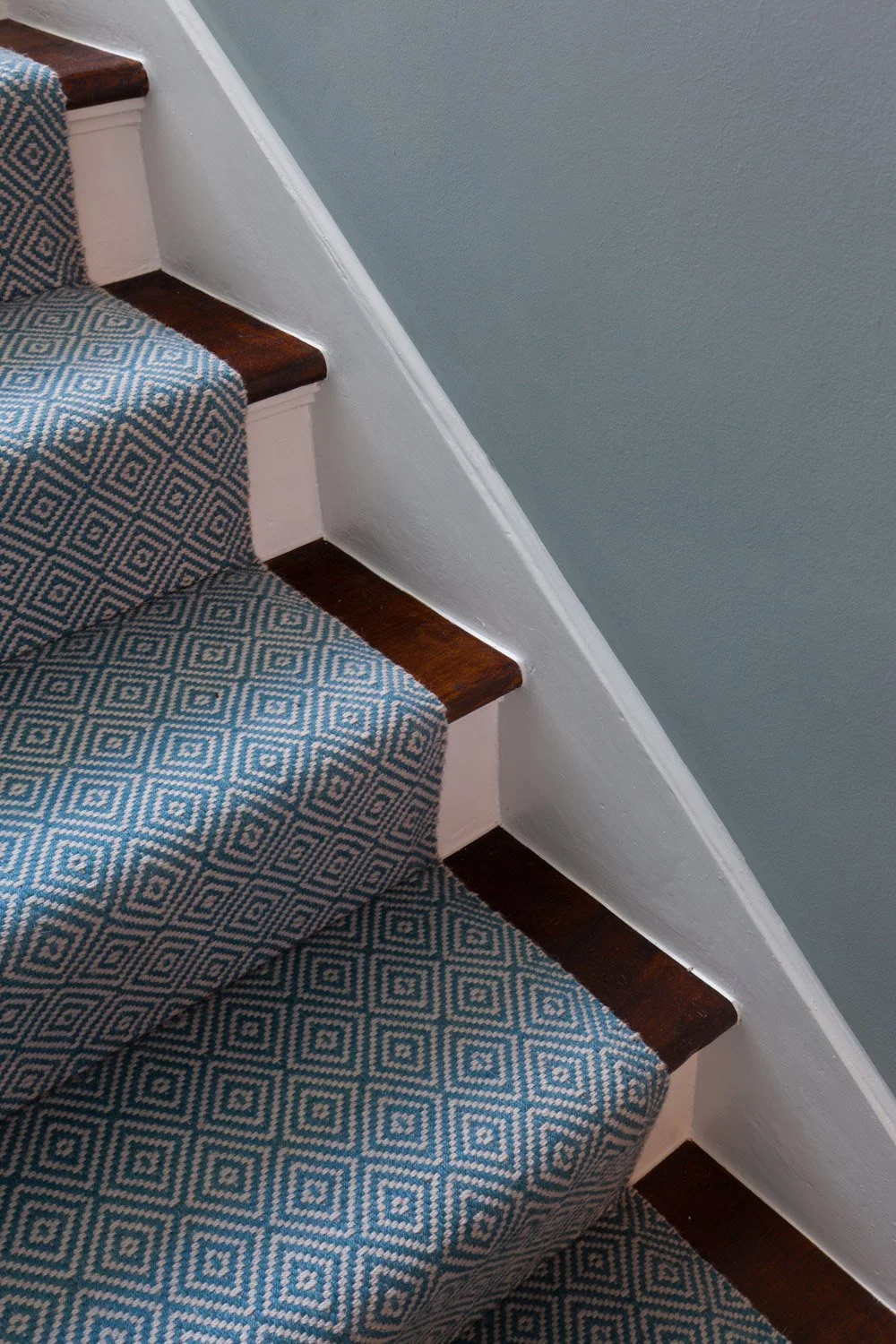
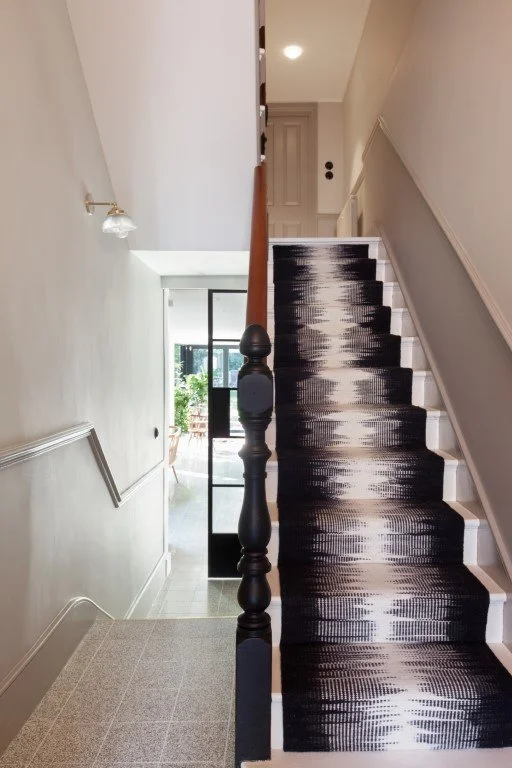
Wallpaper, paint, gradient effects, metallic finishes, stair runners — each of these can carry a stairwell. A wallpaper in a confident pattern, climbing the full height of the void, turns the staircase into a contained world. A stair runner in a strong colour or pattern, fitted neatly to the treads, brings warmth, acoustic softness, and a layer of texture to a surface that would otherwise feel cold underfoot. The trick, as with every other interior decision, is to commit. A staircase that has been half-considered will look half-considered. A staircase that has been designed with intention will look like one of the strongest moments in the house.
Light moving through the stair
A staircase is a place that is used at all hours — early morning, late evening, the middle of the night when a child needs water. The lighting has to do several different jobs, and the typical single overhead pendant rarely manages any of them well.
The principle I work with is layering. A primary fitting — a statement chandelier or a series of pendants dropping through the stairwell void — anchors the space and provides drama after dark. Beneath it, integrated LED strips along the edges of the treads, or beneath the handrail, provide low-level navigation lighting that doesn't require the main lights to be switched on. Recessed wall-washers and concealed strip lighting in joinery niches add a third register, picking out architectural detail and giving the stair atmosphere as well as illumination.
Several circuits are essential. The same staircase that reads as theatrical at seven in the evening, lit by its pendant and its wall sconces, needs to read as quiet and subtle at three in the morning, lit only by the LED strip beneath the handrail. Dimmable controls and zoned circuits make this possible. If you are rewiring as part of a renovation, this is the moment to invest in the wiring infrastructure — the staircase rewards layered lighting more than almost any other room in the house, and getting it wrong is expensive to correct after the plasterwork has gone on.
The detail in the balustrade
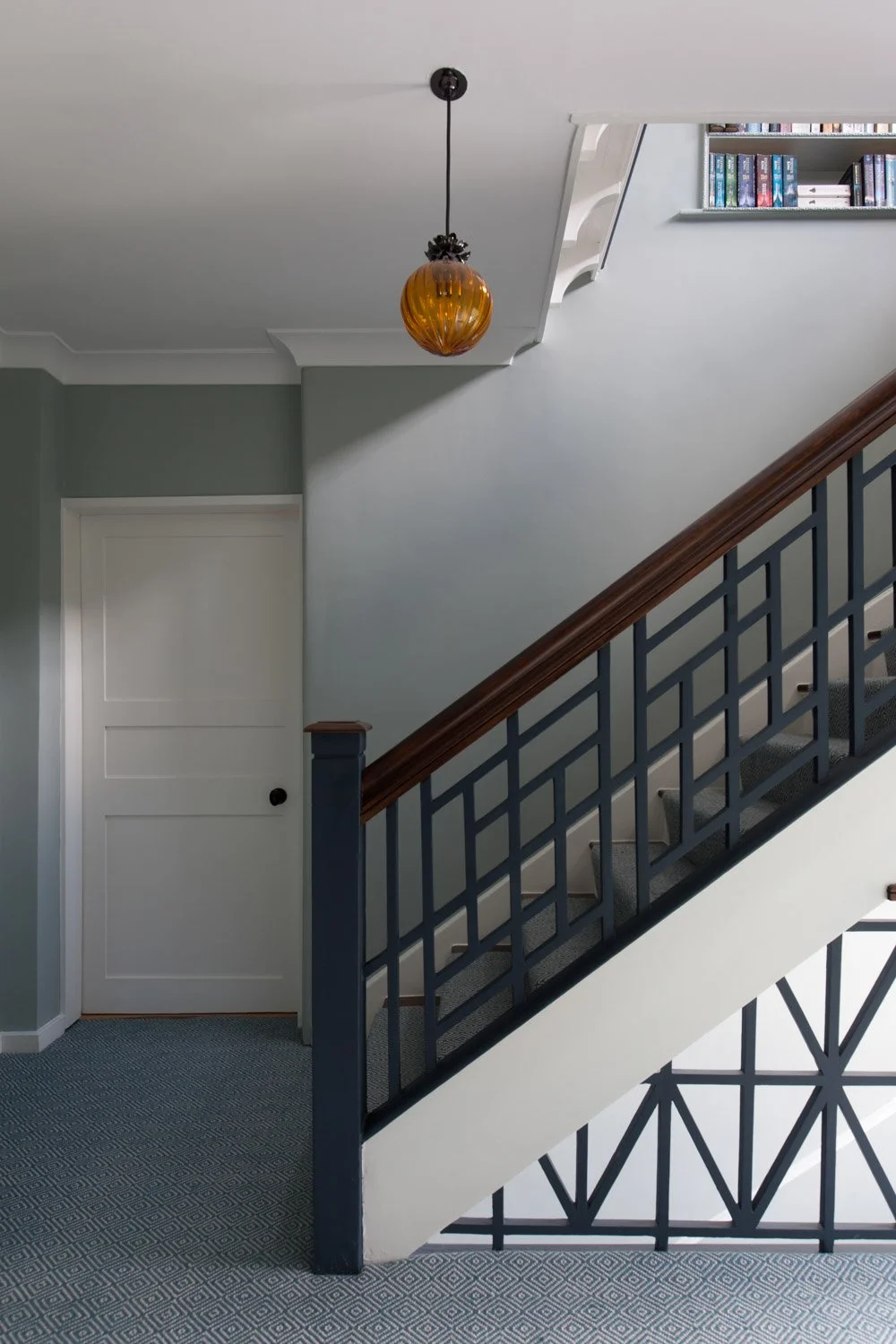
The balustrade is to the staircase what the cornice is to a room. It is the small architectural detail that, executed well, lifts the entire space — and executed badly, leaves it looking ordinary.
Bespoke ironwork remains one of the most satisfying ways to spend the budget on a staircase. Hand-forged metalwork in a custom pattern carries a level of craftsmanship that no off-the-shelf system can replicate, and it ages beautifully over the decades. In period properties we have restored original wrought ironwork and added new pieces designed to match. In contemporary projects we have used minimalist steel verticals, glass panels with discreet brass fixings, and slim brass handrails that read as jewellery against a bolder stair.
Glass balustrades suit modern interiors where weight is the wrong note — the stair appears lighter, sightlines through the home are preserved, and natural light moves further into adjoining spaces. Wood balustrades, paired with metal spindles or set against a painted spine wall, suit more traditional schemes. Whichever language a project asks for, the principle holds: this detail is worth designing properly.
The wider architecture around the stair benefits from the same scrutiny. In several projects we have cut openings into stair walls, sometimes framed in glass, sometimes plain — letting light bleed through the upper floors, revealing views into adjoining rooms, or simply allowing the eye to register that the building has volume rather than only floors. Cornicing, panelling, archways, mirrored panels at half-landings — each of these is a deliberate choice in a stairwell. The mistake is to leave the architecture incomplete. Either the staircase is prominent and richly detailed, or it is plain and quiet. What it should not be is half-resolved.
What the staircase can do for the house
A staircase brings two pieces of architectural space with it that most interior designers underuse — the volume beneath it, and the landings it serves.
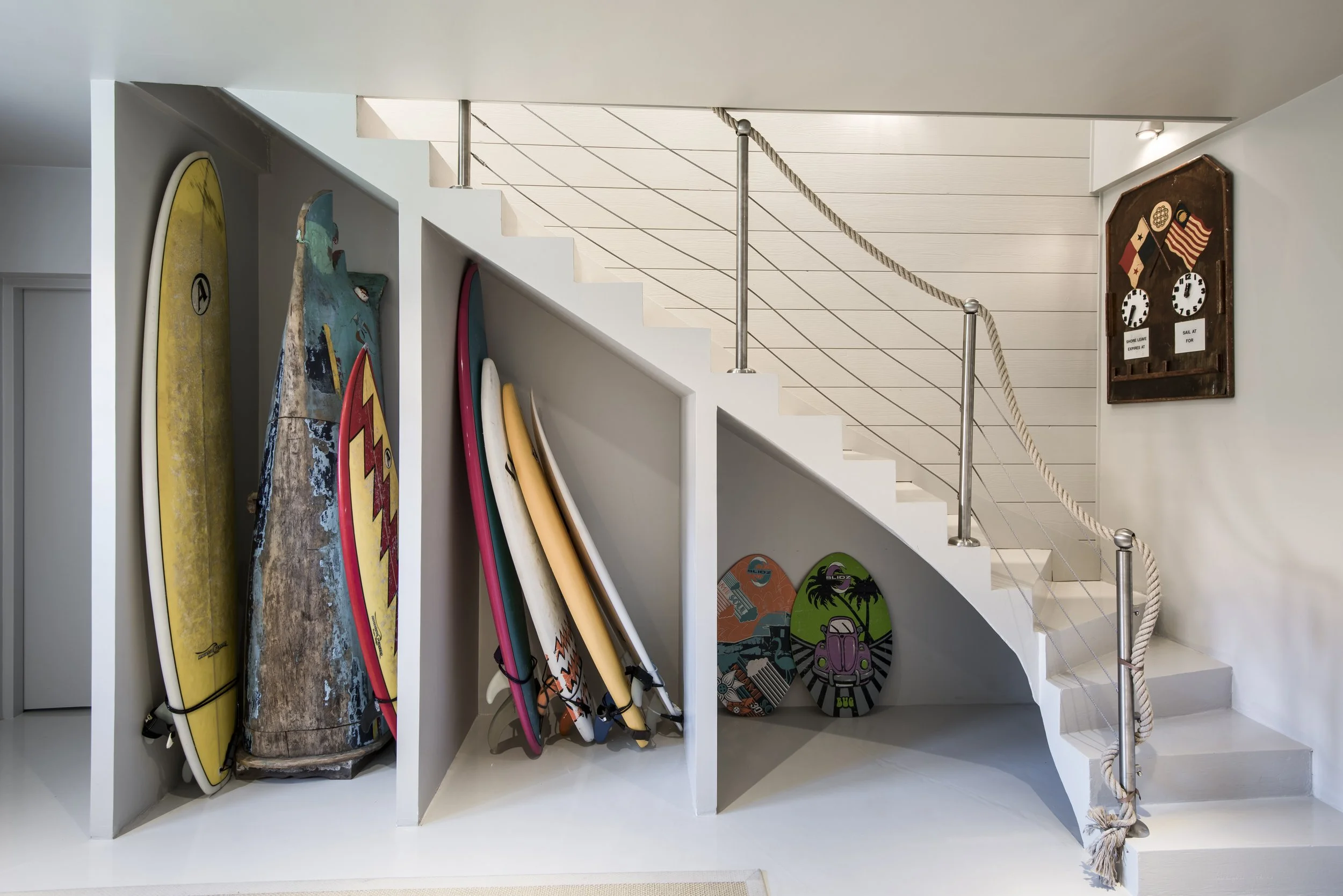
The space beneath a stair is one of the most rewarding voids in a house to design into. In many terraced properties, the ground-floor understair is large enough for a full cloakroom — a small WC, a hand basin, and a narrow door discreetly integrated into the wall panelling. On upper floors, the same volume can absorb a washing machine and dryer, a home bar, or a small wine room with racked storage and a glazed door. The volume that, untouched, becomes a dumping ground for shoes and Hoover bags can, properly designed, take on a discrete and useful function and disappear back into the architecture once it has.
Landings, similarly, are an architectural gift that most houses fail to use. They are small, contained, and naturally rich in light if positioned next to a window — perfect for a feature nook, a built-in bench, a console table with a lamp and a piece of art above it. In one project we placed an upright piano on a half-landing to create what the family came to call the music landing — a small contained space where the children practised and where the building came alive to the sound of imperfectly played Chopin most afternoons. In other projects we have used the half-landing to house a vintage wardrobe or a slim chest of drawers, absorbing the family's overflow of coats and bags and turning what would have been a passage into a useful, characterful room in its own right.
The staircase, in the end, is more than the stair itself. It is the spine of the house, the route through the building, the canvas for some of its boldest decisions, and the carrier of two pieces of architectural space that almost every home leaves untapped. Designed properly, it stops being a passage and becomes one of the rooms the family loves most. Designed badly, it stays invisible — but every time someone walks through it, the missing intention is felt.
Do you have a project in mind or require help with choosing the right antiques for your home?
