
Luxury Bathroom Design: A Guide to Layout, Materials and Storage

The Bathroom as the Quietest Room in the House
A bathroom is often the last room to receive real design attention, and the one that quietly sets the rhythm of the day regardless. The first light in the morning, the last calm moment before bed: little else in a house carries that weight so consistently.
Planning before materials
Bathrooms are among the most technically demanding rooms to design, governed by plumbing, heating, ventilation and structural constraints before a single material is chosen. The right approach starts with how a household actually lives: who needs a shower rather than a bath, whether siblings can share a room, whether a bathroom near a gym might reasonably double as a laundry space.
In one of our more complex reconfigurations, we moved every wall and pipe beneath a sloped roofline to create a sense of spaciousness that the original layout never had. A glass-brick corner wall brought in natural light; a mirror-clad joinery unit concealed the boiler entirely. Technical constraints, handled properly, tend to produce the most interesting design decisions rather than the most limiting ones.

Layout and circulation
The best bathroom layouts are the ones nobody notices, because everything simply works. Circulation matters from the first glance through the door: the eye should land on a vanity or a freestanding bath, not the toilet, and in many older homes, simply swapping the position of the WC and the basin changes the entire feel of the room on entry.
Small adjustments carry real weight. Borrowing a few inches from an adjacent corridor can turn a cramped shower into a generous one. In larger rooms, a half-height wall or glass partition can separate wet and dry zones while keeping the space visually open; in one project, we positioned a bath on a raised platform beneath a roof window, with the shower and vanity forming a more functional zone to one side. The result read as architectural rather than merely practical.
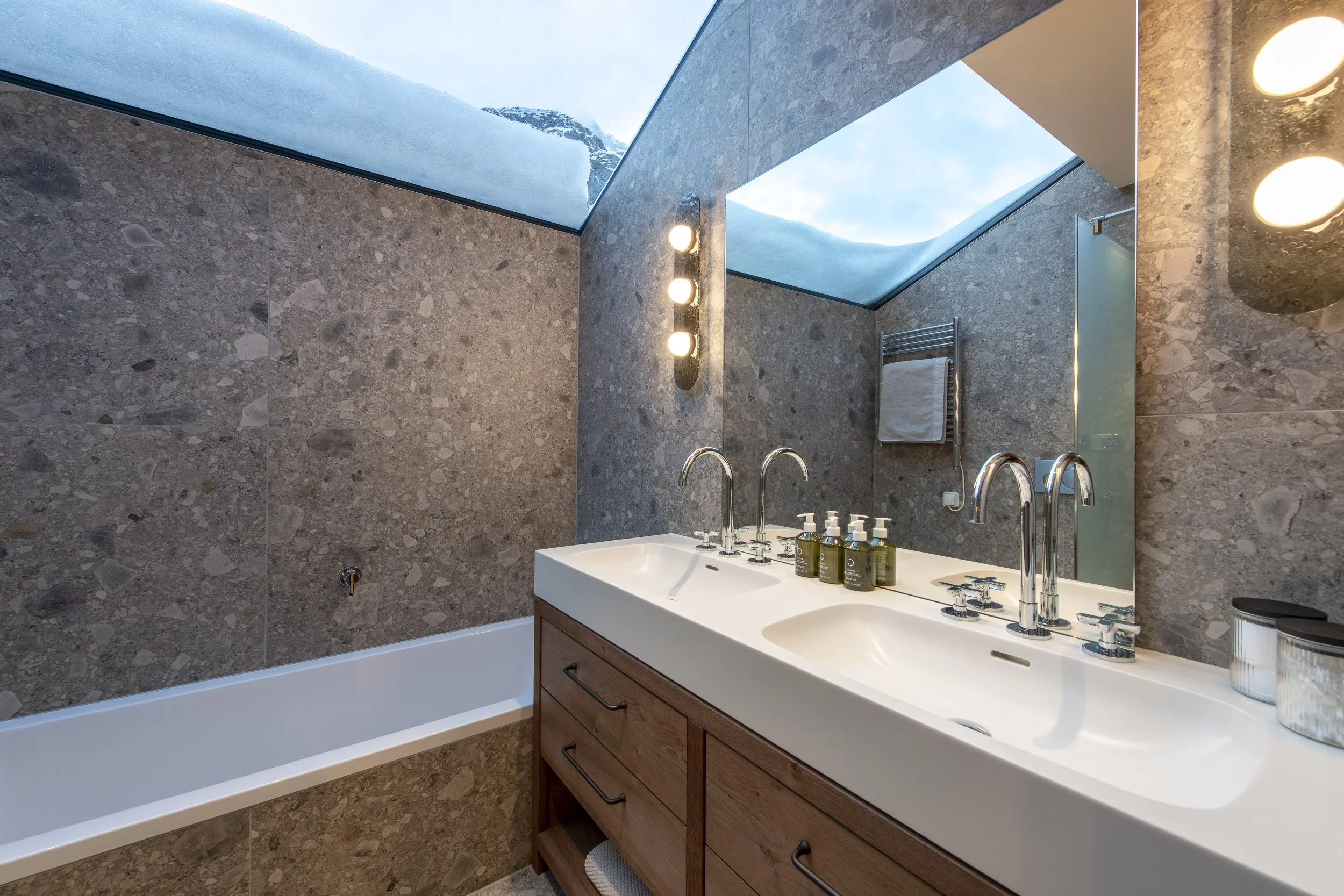
The room's own geometry should generally lead. A long, narrow bathroom benefits from strong symmetry, a centred vanity and a line of tiles drawing the eye through the space. A square room tends to resolve better when zones are layered along one wall. Low ceilings favour vertical tiling or a tall mirror; high ceilings settle better with panelling or a darker lower half, bringing the proportions back to human scale. In a chalet attic conversion, we tucked a bath beneath the eaves and replaced a section of roof with a single glass pane, flown in by helicopter, turning a cramped corner into a room with mountain views.
Where the layout genuinely doesn't serve the way a family lives, structural change is worth considering: moving a wall, a window, a door. A bathroom has to function for daily life first.
materials
Material choice is where a bathroom's personality actually emerges, and it has to answer to touch and performance as much as appearance. Natural stone, marble, limestone, travertine, remains the most enduring choice; large-format or bookmatched slabs let the veining run continuously across a room and remove the sense of visual clutter that comes from smaller tiles. In a recent Surrey Hills project, seven bathrooms were designed in soft greys, blues and greens, each with its own combination of floor, wall and accent tile, twenty-one materials in total, coordinated rather than matched.
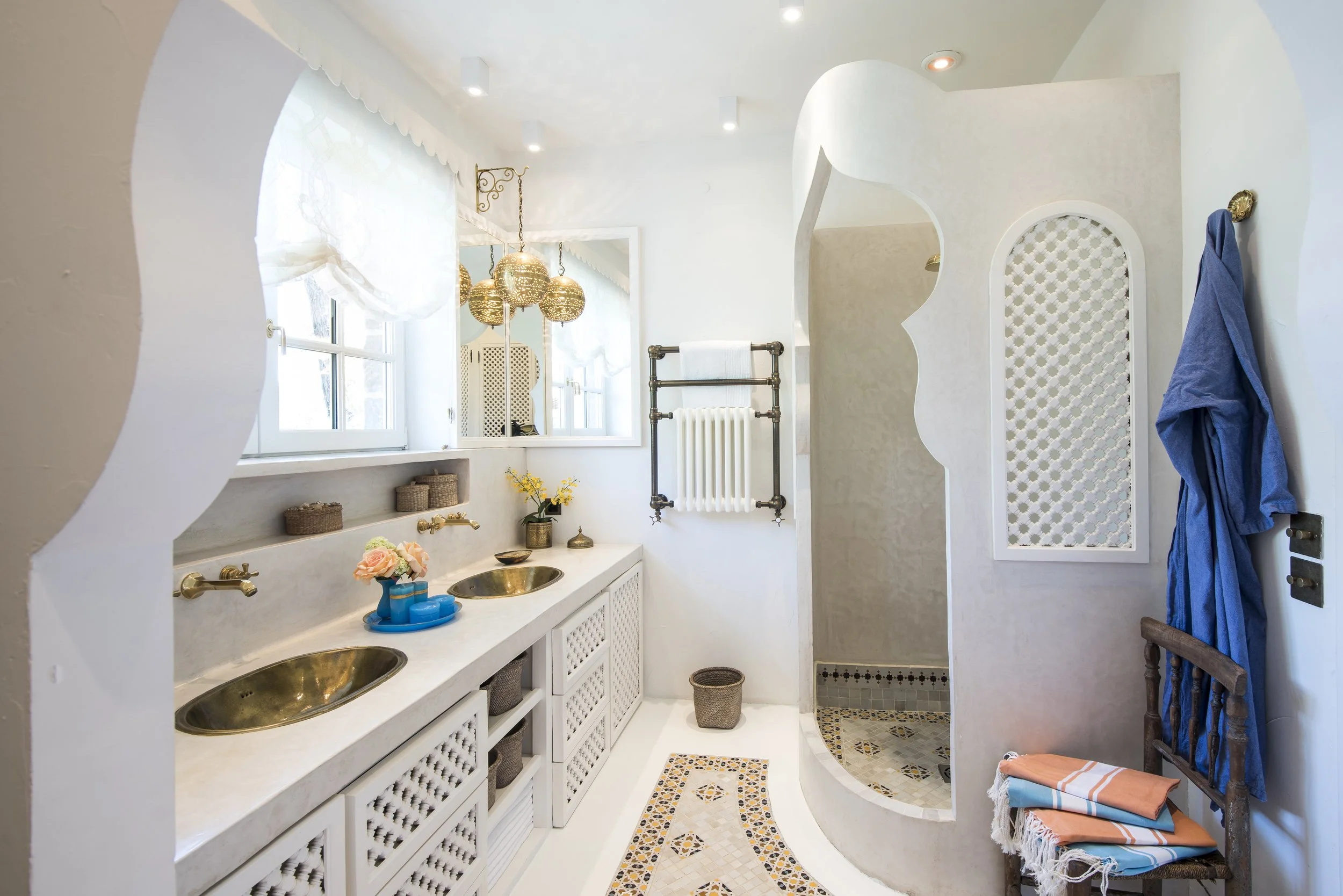
Porcelain has become a genuinely credible alternative where stone isn't practical, now capable of replicating marble's movement with far less maintenance. Microcement and tadelakt, a traditional Moroccan plaster, offer something softer and more tactile still; a Moroccan house project used both across walls and vanities for a seamless, waterproof finish. The best schemes tend to combine rather than commit to one material entirely: porcelain or quartz on the main surfaces, natural stone reserved for a splashback or shower feature.
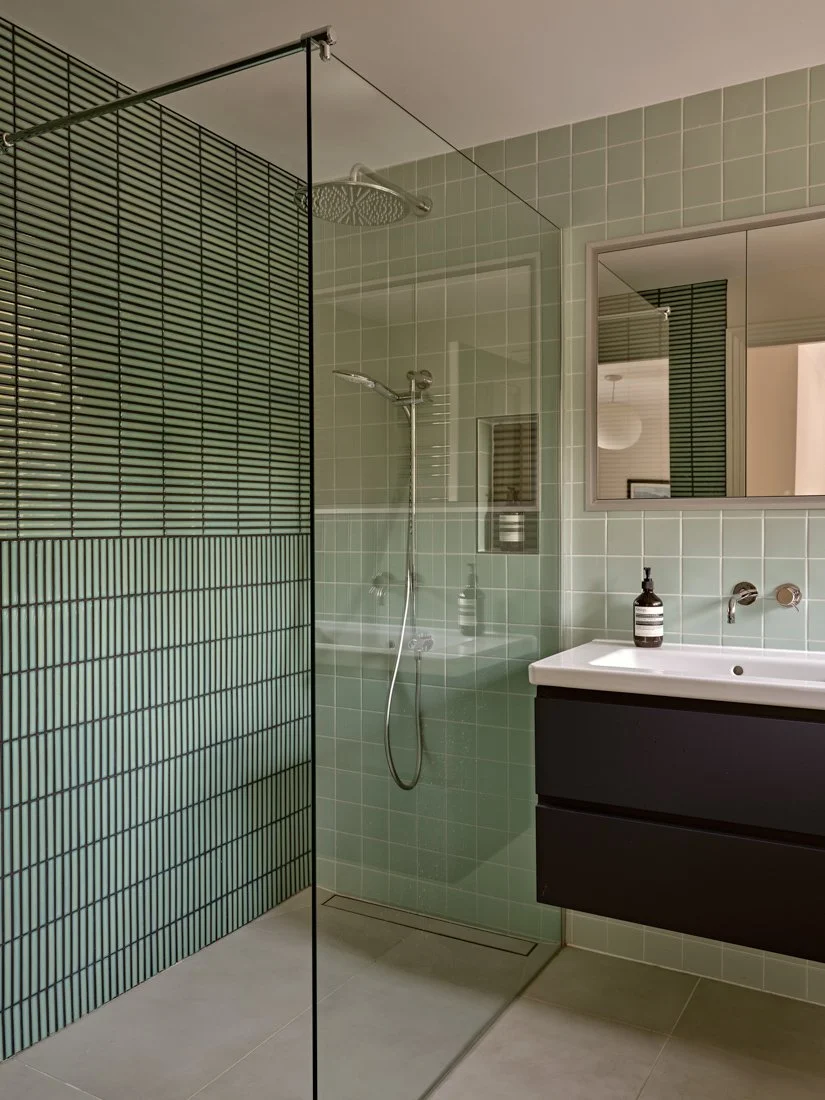
Showers have moved from enclosure to architectural feature. A frameless glass screen keeps a room feeling open; recessed niches, lit with a discreet LED strip, remove the need for shelving altogether. A bath, where space allows, can carry real emotional weight: a freestanding form in a colour other than white, positioned beneath a window or a pitched ceiling. One bath sits in front of a mosaic reproduction of Klimt's The Kiss, commissioned years ago as a feature wall. The strongest schemes generally come from contrast rather than a single expensive material: cool marble against dark walnut, warm limestone against brushed brass.
lIGHTING
Lighting is the difference between a bathroom that works and one that feels considered. Layering ambient, task and accent sources, ceiling lights for general illumination, sconces beside a mirror to avoid harsh shadows, integrated LEDs beneath a vanity for a softer glow, does more than any single fitting could alone. Dimmable circuits matter more than almost anything else here: brightness in the morning, softness in the evening, with a low-level motion-sensor light at night for movement without disruption. IP ratings near water sources are a technical detail worth getting right with an electrician rather than approximating.
STORAGE
A calm bathroom is, more than anything, an ordered one. Storage works best when it's planned before the design begins, sized to what a household actually needs to keep there, and built into the architecture rather than added afterwards. Mirror-fronted cabinets above a basin do double duty, reflecting light while concealing daily essentials. In one house, an entire small room was designed as bathroom storage: pull-out laundry baskets, drawers for household toiletries, deep linen storage, all built into a single wall of joinery.
Not everything needs to be hidden. A stack of folded towels, a row of glass jars, a candle beside the bath, these details make a room feel lived in rather than staged. In one coastal project, a row of rolled bikinis stored on open shelving beside the shower added colour and a sense of ease to an otherwise minimal room.


fixtures
Fixtures are the details a hand meets every day, and their quality tends to be remembered longer than almost anything else in the room. Consistency across sanitaryware and towel rails, nickel, chrome, brass, matters more than any single finish choice; other elements, handles, switches, light fittings, can vary more freely. Unlacquered brass ages and darkens over time, which is worth knowing before specifying it. We work regularly with Fantini, Vola, Dornbracht, Studio Ore, Lefroy Brooks, Samuel Heath and Grohe, largely because the engineering behind a tap or mixer shows up in daily use long after the tile choice is forgotten.
the vanity
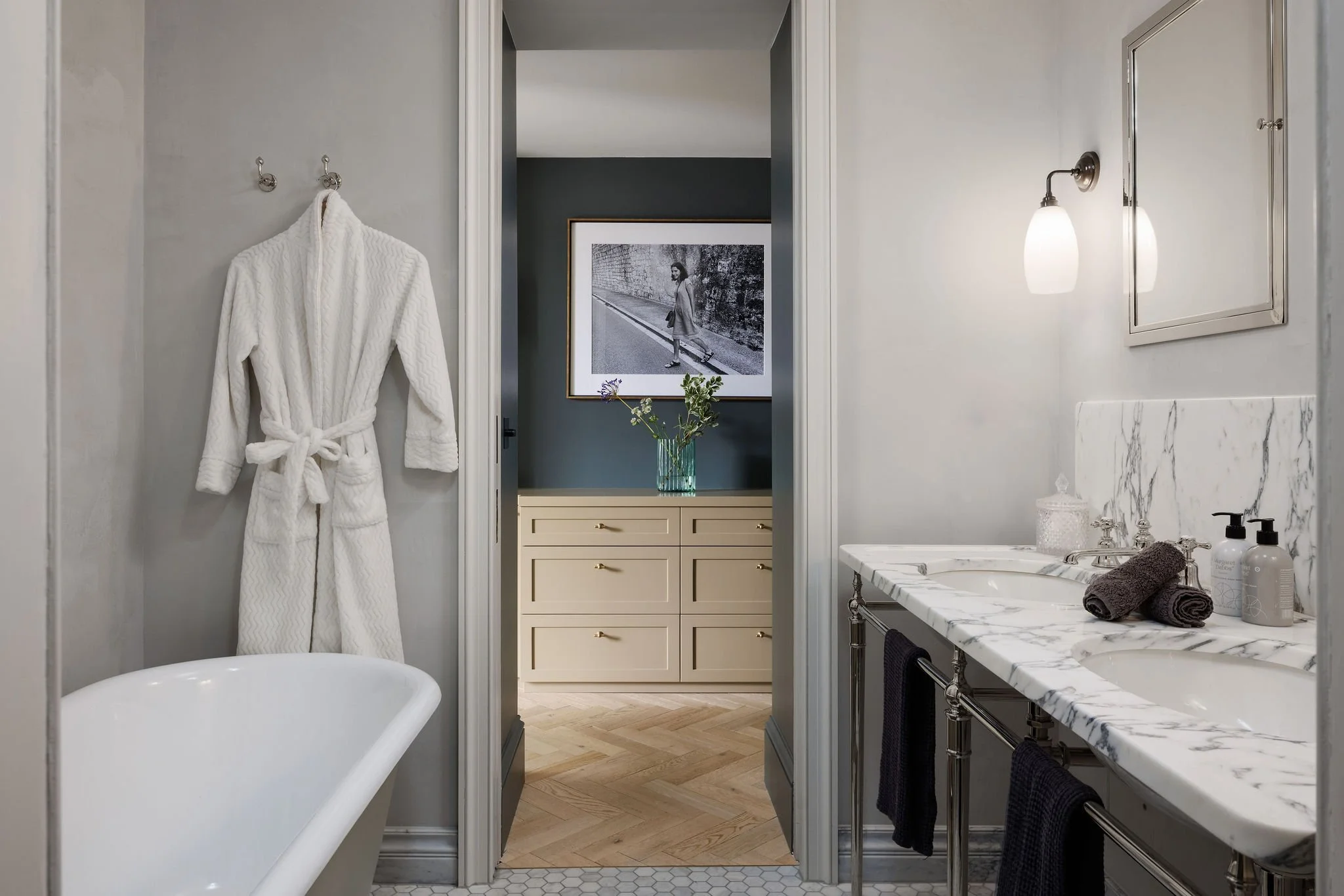
A vanity is often the room's real centrepiece. Reclaimed or vintage furniture, a 1950s teak credenza fitted with integrated basins, an antique chest with its proportions preserved, brings a sense of history that no new piece can replicate, provided it's properly sealed and finished for a wet environment. Where a bespoke piece makes more sense, proportion leads: a long linear vanity for a narrow room, twin basins framed within a single sculptural counter for a larger suite. Stone cladding gives permanence, timber gives warmth, and the grain direction alone can elongate or widen a room's apparent proportions.
colour
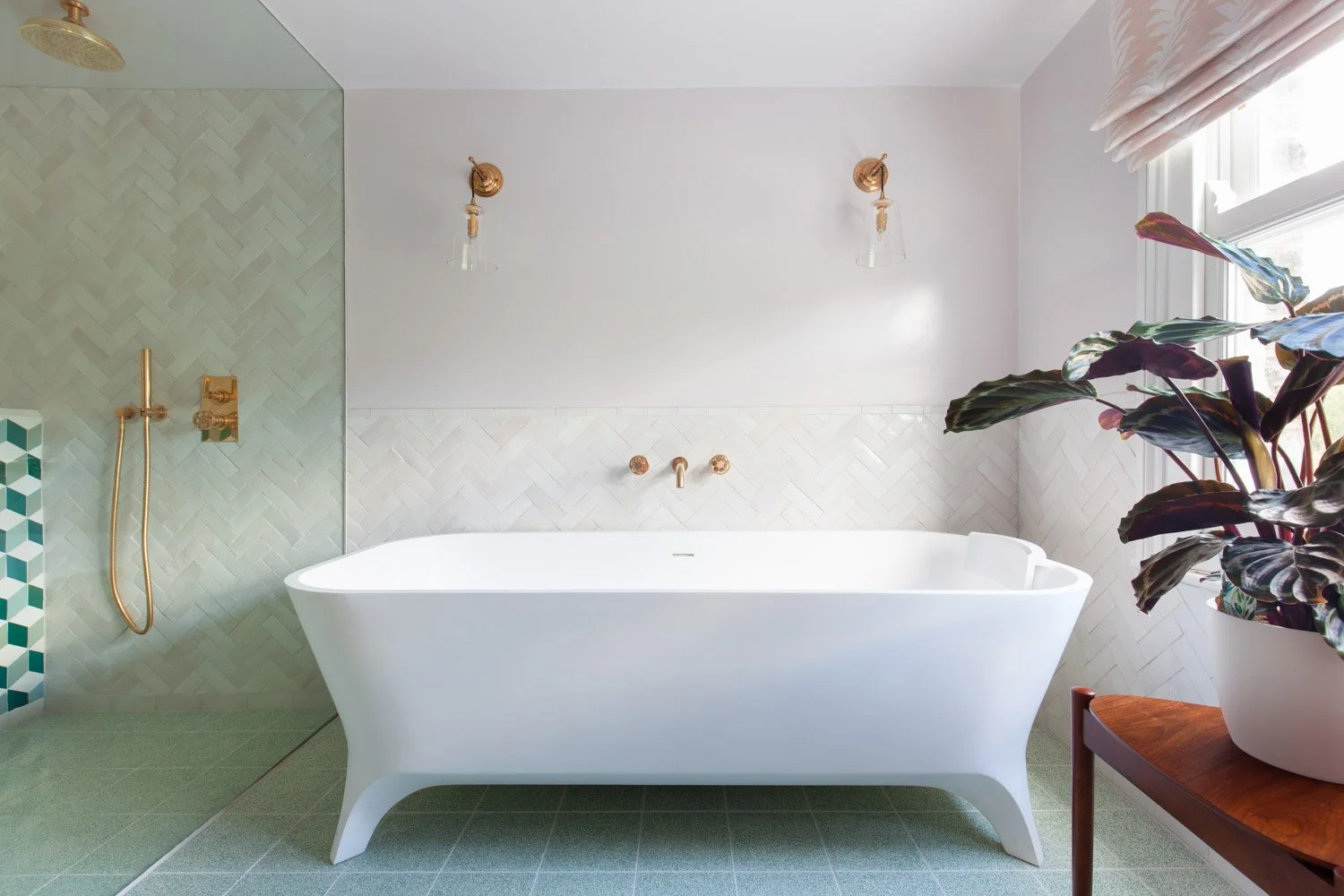
Colour softens a room dominated by hard, reflective surfaces. North-facing bathrooms tend to suit warmer tones; south-facing rooms can carry bolder ones. Where there's little natural light, deep tones, charcoal, forest green, navy, often read better than pale ones, which can feel flat without sun to lift them. Soft neutrals remain the most enduring choice, particularly when their undertones are pulled from the veining in a piece of stone rather than chosen independently. In one project, the deep charcoal-navy in a marble's veining was picked out for the painted wall sections, a quieter way to introduce contrast than adding an unrelated colour.
The final layer
Once the architecture and materials are resolved, the smaller gestures, linen, a woven basket, a single sculptural stem, a piece of art tolerant of humidity, are what make a bathroom feel personal rather than simply well specified. Restraint matters here as much as anywhere: one or two considered objects read as curated; too many read as clutter.
A bathroom rarely announces its own thinking. Done well, it simply feels resolved, and that quality tends to be the hardest one to notice until it's missing.


Do you have a project in mind or require help with bathroom renovation for your home?