
petite chic
Interior architecture
CITY | BATTERSEA POWER STATION

Downsizing after thirty years, the clients began again entirely: every piece in their new Gehry apartment designed from scratch, around the art they could not leave behind.
LOCATION: Battersea Power Station, London
PROJECT TYPE: Full interior design and bespoke joinery. Off-plan appointment with developer alterations. Complete furnishing from scratch.
SCOPE: Off-Plan Consultancy · Developer Specification Review · Interior Design · Bespoke Joinery · 3D Spatial Modelling · Colour and Materials · Lighting Design · Art Curation and Placement · Full Furnishing · Styling
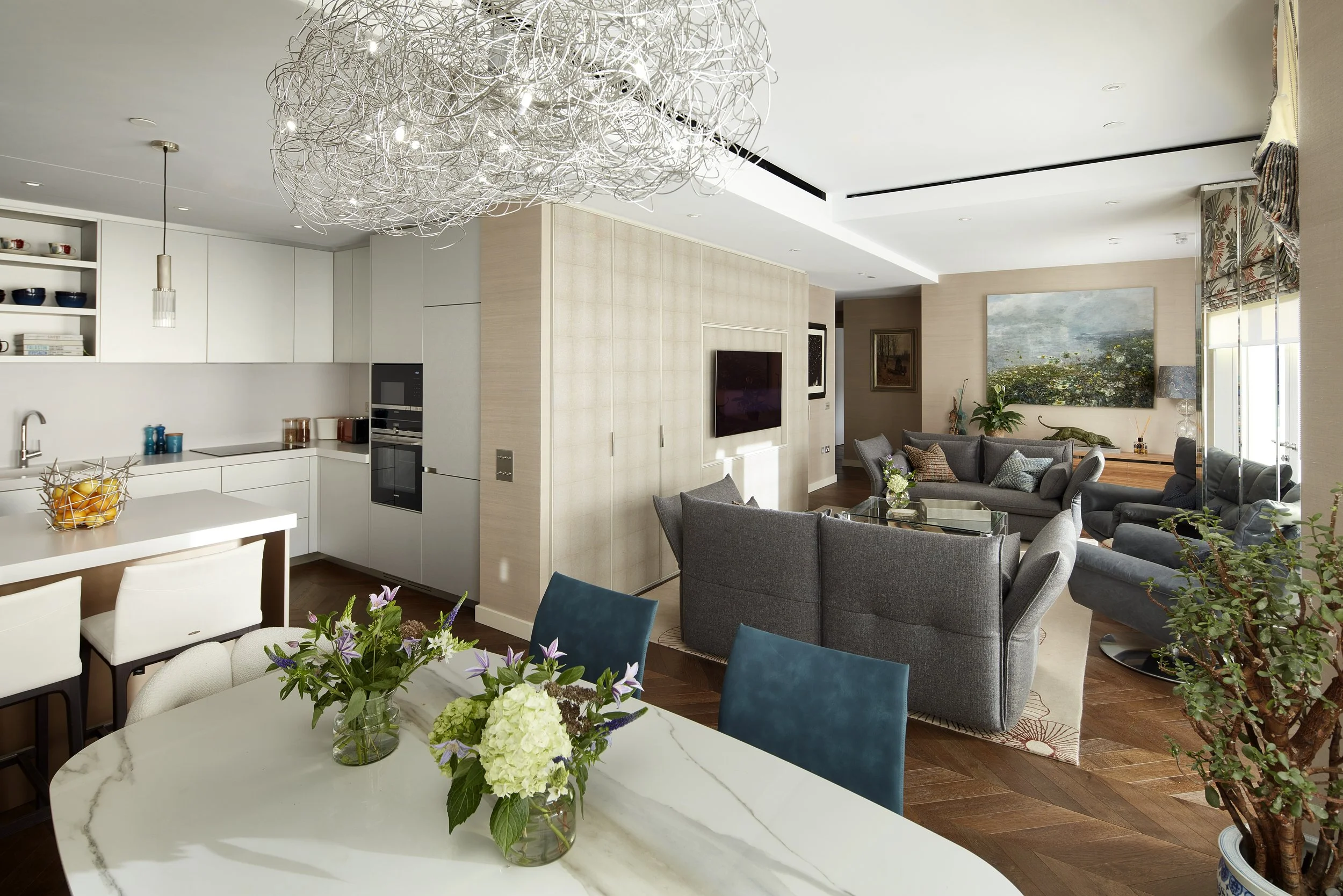
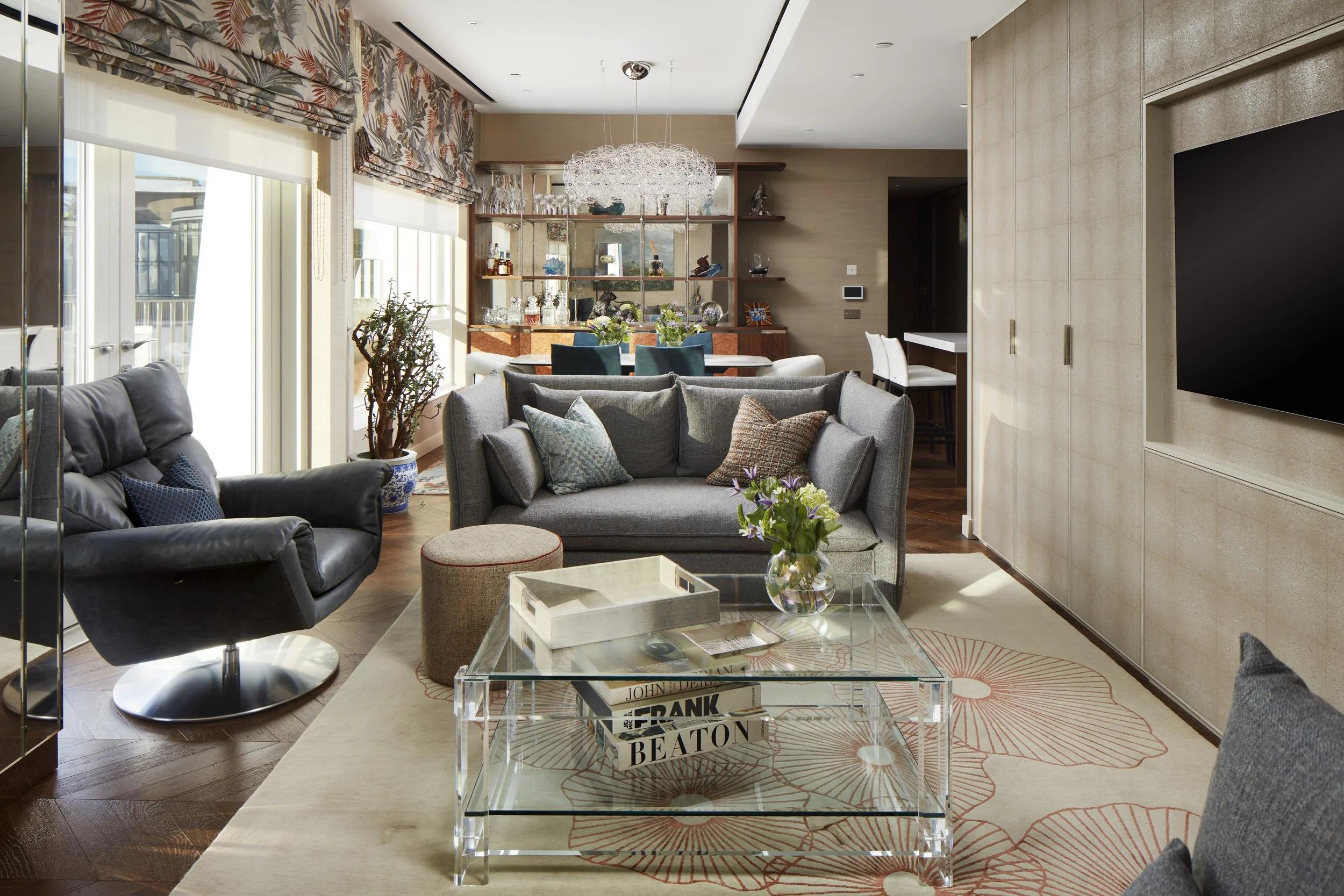
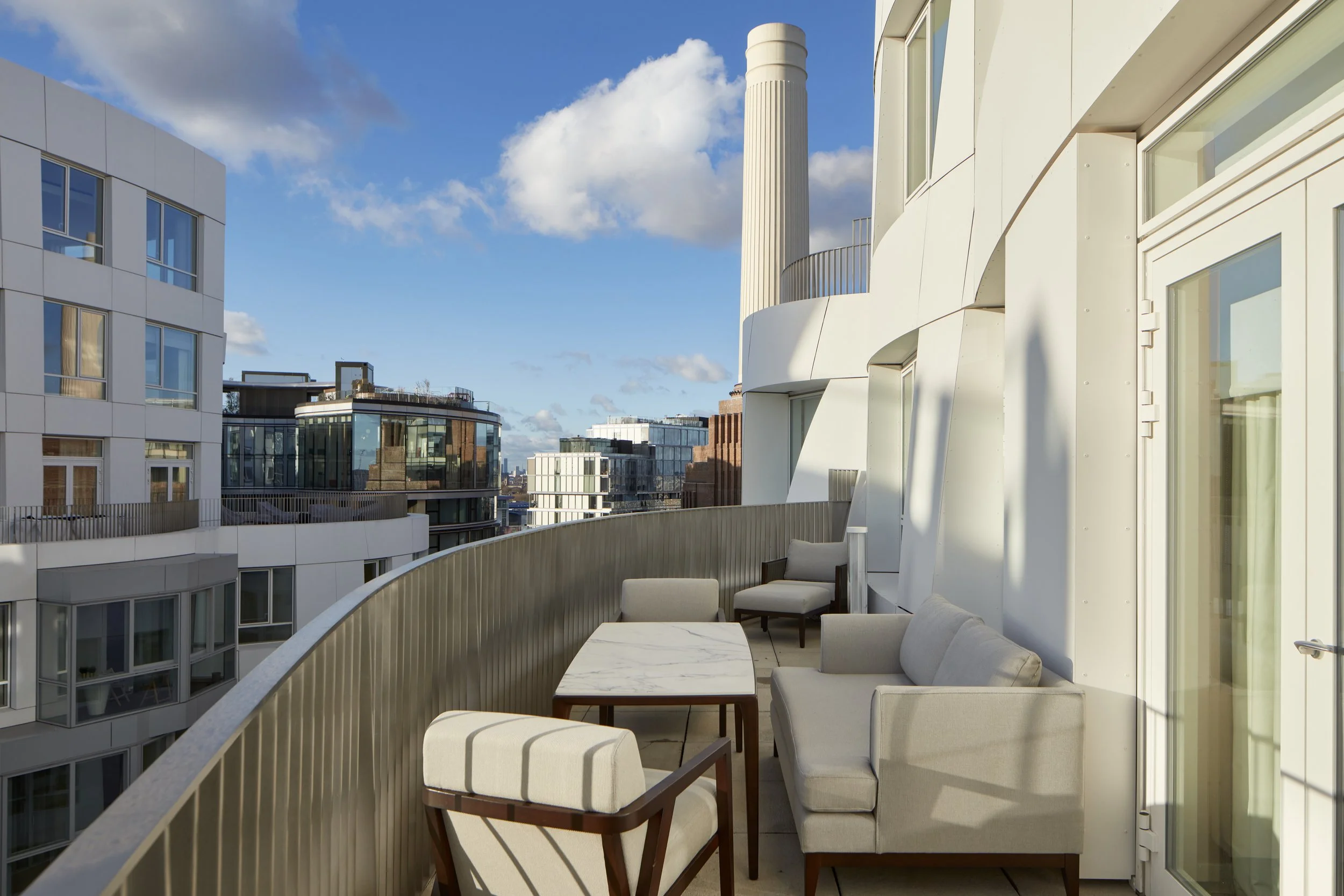
Thirty years in one house leaves a mark, and the accumulated objects of a life fully lived. When this couple’s children had grown and the family home in the suburbs had served its purpose, they faced a choice many people approach with caution, and they approached with genuine ambition: not to find something smaller and similar, but to begin again entirely. A three-bedroom apartment at Battersea Power Station’s Prospect Place, Frank Gehry’s sculptural residential towers at one of London’s most celebrated addresses, would become their new city base, with time divided between London, the countryside and Spain.
They called us the moment they signed, and that early appointment shaped everything that followed. A developer’s specification, however considered, is designed for a hypothetical occupant. By arriving before the building was finished, we could walk the shell in hard hats, read the drawings against the actual space, and secure changes while they still cost only a decision rather than a demolition.
The challenge was spatial and emotional in equal measure. Leaving a home of thirty years means leaving behind not just rooms but the objects that filled them: furniture chosen for spaces that no longer exist, at a scale the new apartment could not receive. What Prospect Place asked for was an entirely new design language, bespoke in every dimension, scaled to the particular geometry of Gehry’s rooms, and drawn in spirit from the Art Deco furniture collection the clients had loved and left behind.





THE BRIEF
The emotional weight of this brief was considerable, and we took it seriously. Leaving a family home of thirty years is not simply a logistics exercise. It is the end of a chapter that held everything: the raising of children, the accumulation of objects, the particular comfort of a space shaped and reshaped across decades by the people who live in it. The clients were not downsizing out of necessity. They were making a deliberate, ambitious choice: to move to one of London’s most significant new addresses, to live between three locations, and to approach this new chapter with complete design conviction.
The rooms were allocated with precision: a master bedroom suite; a guest room where the two beds needed to be separable for individual use; and one room that had to work at once as a home office, a bridge room and an occasional guest space. Three rooms, each with a compound brief. Everything designed to work within the particular architectural character of Frank Gehry’s Prospect Place, a building where no wall is straight, no room is rectangular, and the sculptural language of the exterior is present on every interior surface.
“Claudia and her team have captured our style and given it both warmth and sophistication which we would never have found ourselves. We visited a home where the joinery work had already been completed and were immediately confident in both the craftspeople and the standard of finish. We worked from designs in 3D and site visits which were complicated to arrange but Claudia carried us through with calm authority.”
- Clients, Starting Over — Battersea Power Station
The OFF-PLAN ADVANTAGE
Bringing in an interior designer at the off-plan stage of a major development is not an indulgence. It is the one moment when the most can be changed for the least. Developer specifications are drawn for a generic occupant. The AV routing, the lighting circuits, the electrical layout, the position of doors, the specification of the wardrobes: none of these is decided with a particular family’s life in mind. Arriving before the building is complete is the only point at which they can be changed without structural cost.
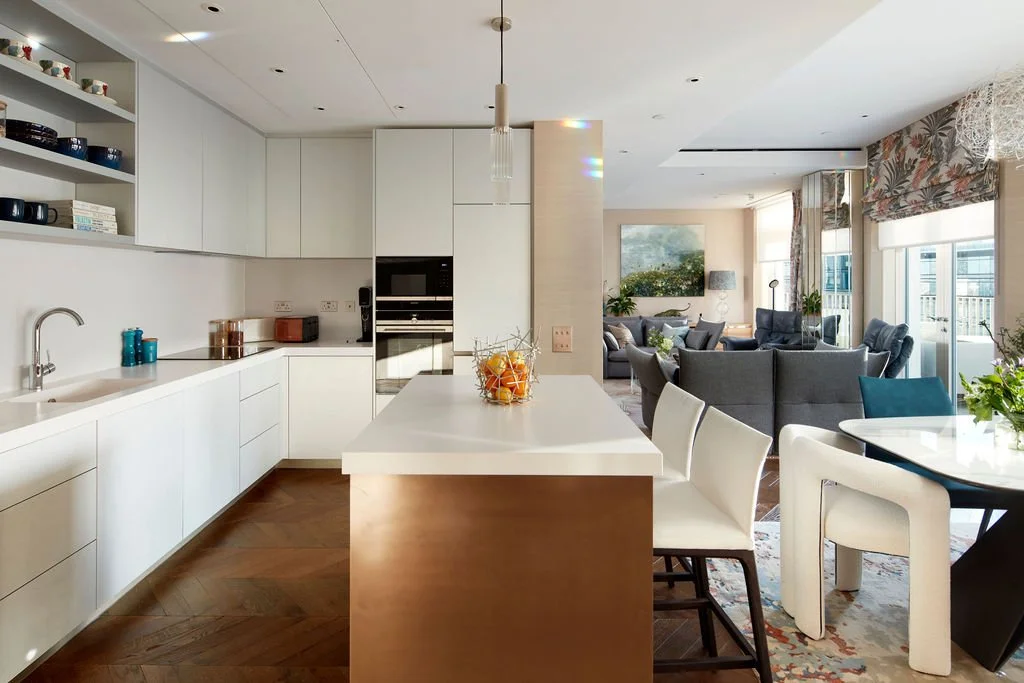
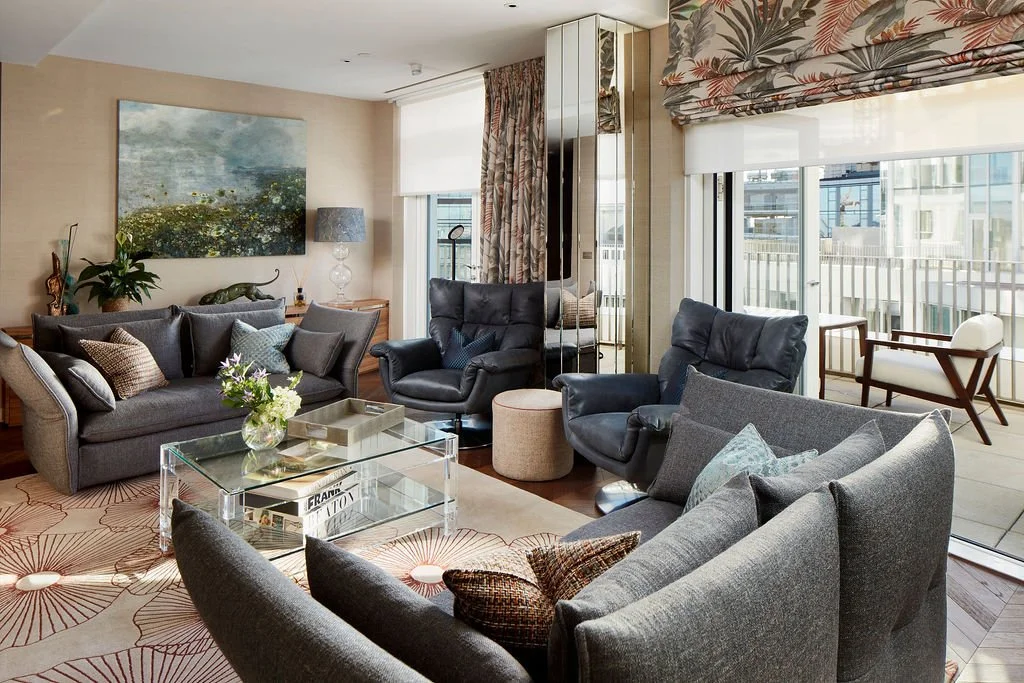
We walked the shell with the clients in hard hats, reading the architectural drawings against the actual space. The changes we requested from the developer were targeted and significant: a doorway repositioned for better flow between the living spaces; a structural column clad in mirrors, turning an awkward interruption into a light-multiplying feature; the kitchen island given a bespoke overhang for seating; the wardrobes upgraded from the developer standard to a specification that would work properly for long-term living. Each of these would have been expensive or impossible to reverse after completion. Made at the right moment, they cost only the decision.




The EDIT
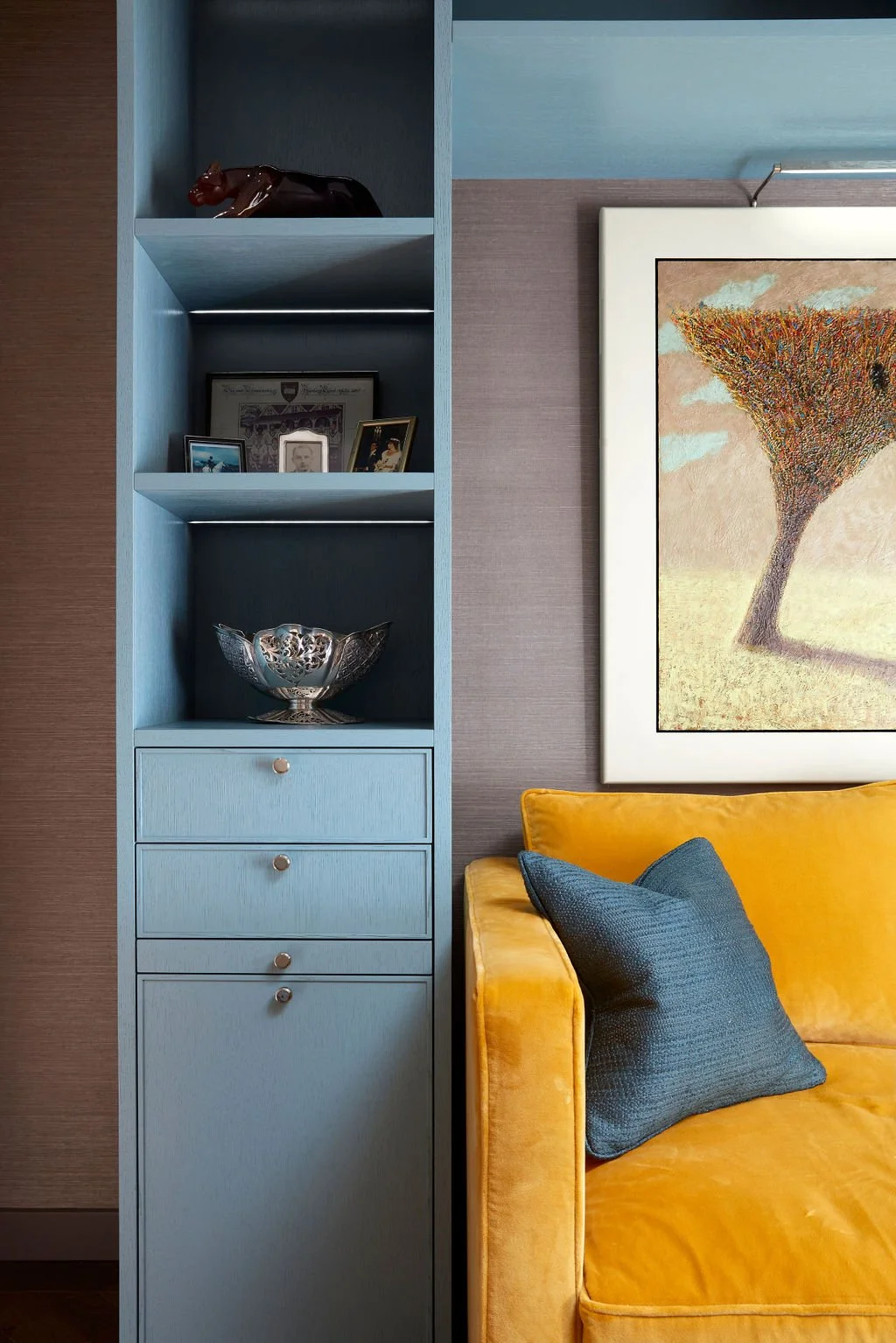
The most important thing we said to the clients was also the hardest for them to hear: do not bring the furniture. Thirty years of accumulated pieces, however beautiful, however personally significant, had been designed for rooms that no longer existed. The proportions, the scale and the material character of Prospect Place were entirely different from the suburban family home, and furniture that had worked there would have made the new apartment feel like a compromise rather than a beginning.
We agreed to take only the artworks and the personal accessories, the pieces with genuine emotional meaning, the ones that would anchor the new home to the life already lived. Everything else was designed from scratch: scaled to the actual dimensions of the Gehry rooms, informed by the clients’ own sensibility, and visualised in full 3D before a single piece was commissioned. Nothing was left to chance. The clients saw their finished apartment in detail before any work began.



THE JOINERY
The architecture of Prospect Place made bespoke joinery not a design preference but a practical necessity. Frank Gehry’s buildings are sculptural in the most literal sense: walls are kinked, rooms have no parallel surfaces, and the angular geometry that gives the building its character from outside creates a series of design problems within. Add the air conditioning and mechanical infrastructure, the skyline windows with their specific light angles, and the structural columns that appear in unexpected places, and the only honest response is to design for these spaces precisely, rather than force standard pieces into rooms that will not receive them.
Every piece of bespoke joinery was drawn in relation to the particular wall it would occupy. The clients’ former home had held a beautiful Art Deco furniture collection, now dispersed, but present in memory and in taste. We took the shapes, proportions and veneer treatments of that collection as the design language for the new joinery: geometric forms, rich wood veneers, the particular combination of warmth and precision that marks great Art Deco furniture, translated into pieces that belonged completely to these rooms and to this stage of the clients’ lives.
“Wallpapers, fabrics, veneers, art, sculpture and lighting come together and everything looks like it was always meant to be this way.”
Art And Interiors
The artworks the clients brought from their previous home were not accessories added once the interior was resolved. They were the foundation the interior was built from. Wallpaper, fabric, veneer and lighting were all chosen in relation to specific works: each considered for its colour, its scale, its tone, its relationship to the room it would occupy and to the pieces around it. Existing works were reframed where the new context demanded it. New acquisitions were chosen to complete the collection in its new setting.
Treating art and interior as a single composition rather than separate decisions is what produces the quality the clients recognised at once: the sense that everything was always meant to be this way, that the wallpaper and the veneer and the art and the lighting arrived at the same moment, as part of a single intention. That impression is the result of a process that treats every element as part of a whole, from the very first conversation.



CITY
Urban Sophistication

Surf
Coastal Serenity

Ski
Alpine Craft
Every home begins with a conversation.
Every project begins with a conversation.
If you are considering a home and would like to talk through your ideas, we would be glad to hear from you.