
ABOVE THE ROOFLINE
Interior architecture & design
City | frankfurt

A century-old Frankfurt building, its long-unused attic reclaimed as a penthouse duplex, where every contemporary intervention belongs to the building rather than imposing on it.
LOCATION: Frankfurt, Germany
PROJECT TYPE: Full interior architecture and design
SCOPE: Interior Design · Interior Architecture · Heritage Liaison · Façade Restoration · Roof Restoration (Hand-Cut Slate) · Structural Coordination · Sustainability Integration · Photovoltaic System · Lighting Design · Bespoke Joinery · Furniture Sourcing and Curation · Window and Door Specification

The clients own a substantial Gründerzeit building in Frankfurt’s Sachsenhausen district, a property built in 1900 in the high classicist style of the period, with the ornate proportions and stately sandstone façade that define the era. Their vision was ambitious: to reclaim the building’s attic, a raw space that had stood unused beneath the roof for over a century, and combine it with the top-floor apartment beneath to create a single penthouse duplex.
The scope reached far beyond interior design. It took in the restoration of the sandstone façade, a complete recladding of the roof in hand-cut slate, the integration of renewable energy, structural reinforcement throughout, and a fundamental reorganisation of every space across two floors. From the first planning meeting to final installation, the work spanned several years.
What makes the home feel resolved rather than assembled is a single editorial discipline: every contemporary intervention had to belong to the building, not impose upon it. The brief was not to drop a contemporary apartment into a historic shell, nor to make a Gründerzeit interior look modern. It was to find the precise points where heritage and contemporary intervention could sustain each other.


The Brief
The brief had three layers, none of which could be considered separately. The first was sustainable development at the level of the building itself: restoring the sandstone façade, recladding the roof, integrating renewable energy, replacing the entire envelope. The second was unlocking the building’s potential, converting an attic that had stood unused for over a century into part of its most valuable living space. The third was the design of the penthouse interior itself.
What clients sometimes assume to be three separate projects, we treat as one. A heritage building cannot be made to perform like a contemporary one through interior design alone: the envelope, the roof, the structural integrity and the energy systems all have to be addressed before a fabric is chosen or a piece of furniture placed. And the structural and heritage decisions cannot be made in isolation from how the home will eventually be lived in. The two sides have to be designed in dialogue, from the first conversation.


THE LONG APPROVAL
Securing planning consent to convert the attic into habitable space was the project’s first hurdle, and it took time. We worked closely with Frankfurt’s heritage department and a local architect team to make the case: to show that the new addition would respect the original roofline and architectural rhythm, and that the building’s identity would be preserved by the work, not diluted by it.
The approval process is rarely something a client wants to dwell on. In our experience it is often the most consequential phase of a project of this kind. The conversation we had with the heritage department in those early months shaped every subsequent decision: what could be opened up, what had to be preserved, where the new architecture could speak in its own voice and where it had to defer entirely. By the time consent was granted, the brief had matured into something more precise than the one we had begun with.
A YEAR OF SLATE
The roof was reclad entirely in hand-cut slate shingles, each one individually shaped and laid by craftsmen working in traditional methods. Photovoltaic panels were then integrated, along with a discreet system of access points serving the solar-powered heating and cooling units that manage the apartment’s temperature. This work alone took nearly a year.
From the street, the reclad roof is indistinguishable from any other slate roof in Sachsenhausen. That is precisely the point. The argument for traditional methods on a heritage building is not aesthetic in the surface sense. It is structural, in the deeper sense of a building’s relationship to its context. A roof of mass-cut, machine-laid slate would have read, even at a distance, as a different kind of object. The hand-cut roof simply continues the building.
“A palette of this conviction only works when the architecture is strong enough to hold it.”

THE STAIRCASE
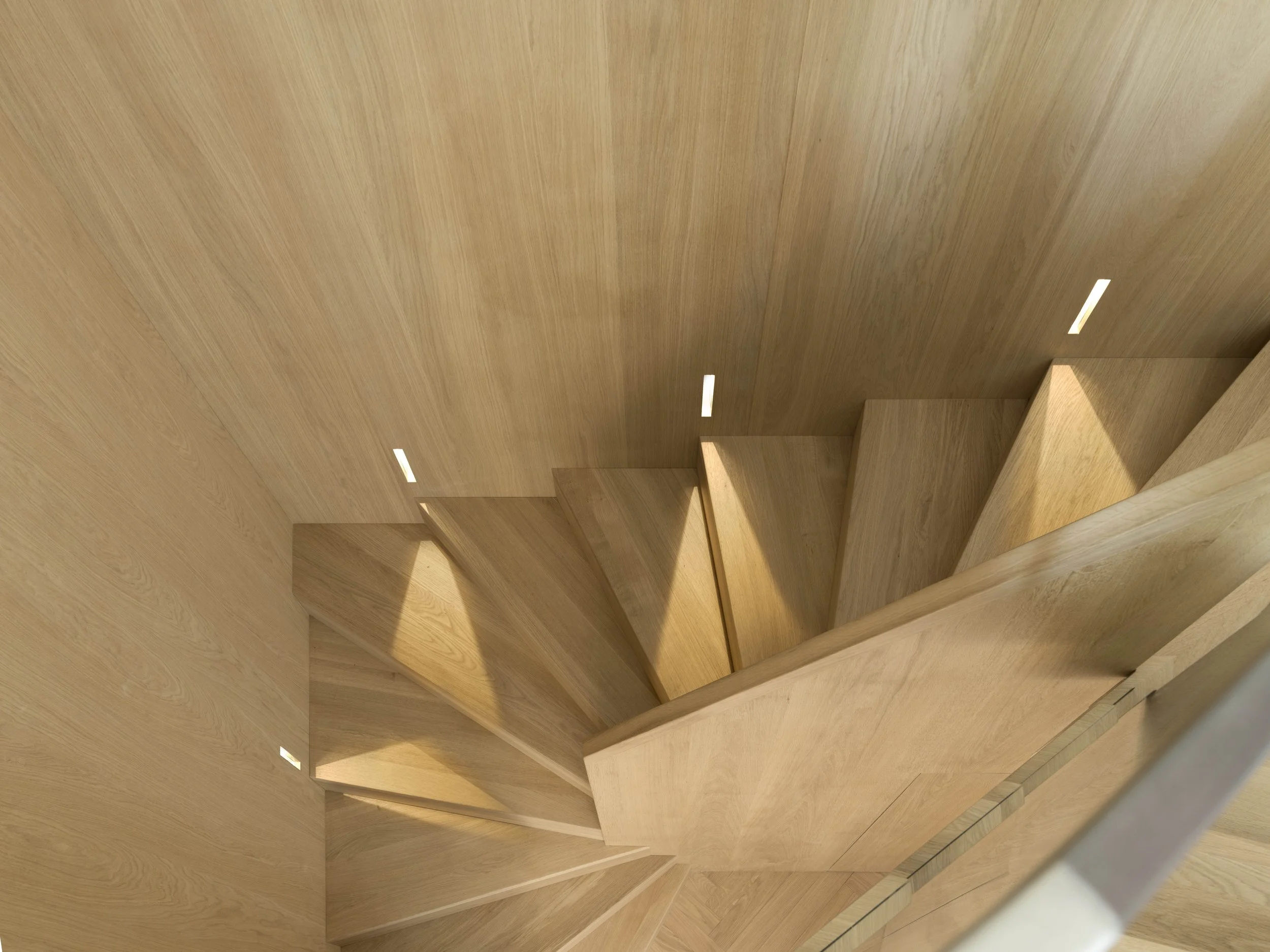
The defining architectural moment of the home is the staircase that connects the two floors. The clients wanted the junction between the original apartment and the new attic to feel like a celebration rather than a piece of necessary infrastructure, and we gave it a generous amount of floor space to make that possible.
The staircase is built entirely in solid oak. Treads, risers, handrail and wall panelling: every element was refined and simplified until the whole reads as a single sculpted form, carved as if from one piece of timber. Integrated low-level lighting runs through the stair, marking the passage from one floor to the next without ever announcing itself.
THE GALLERY
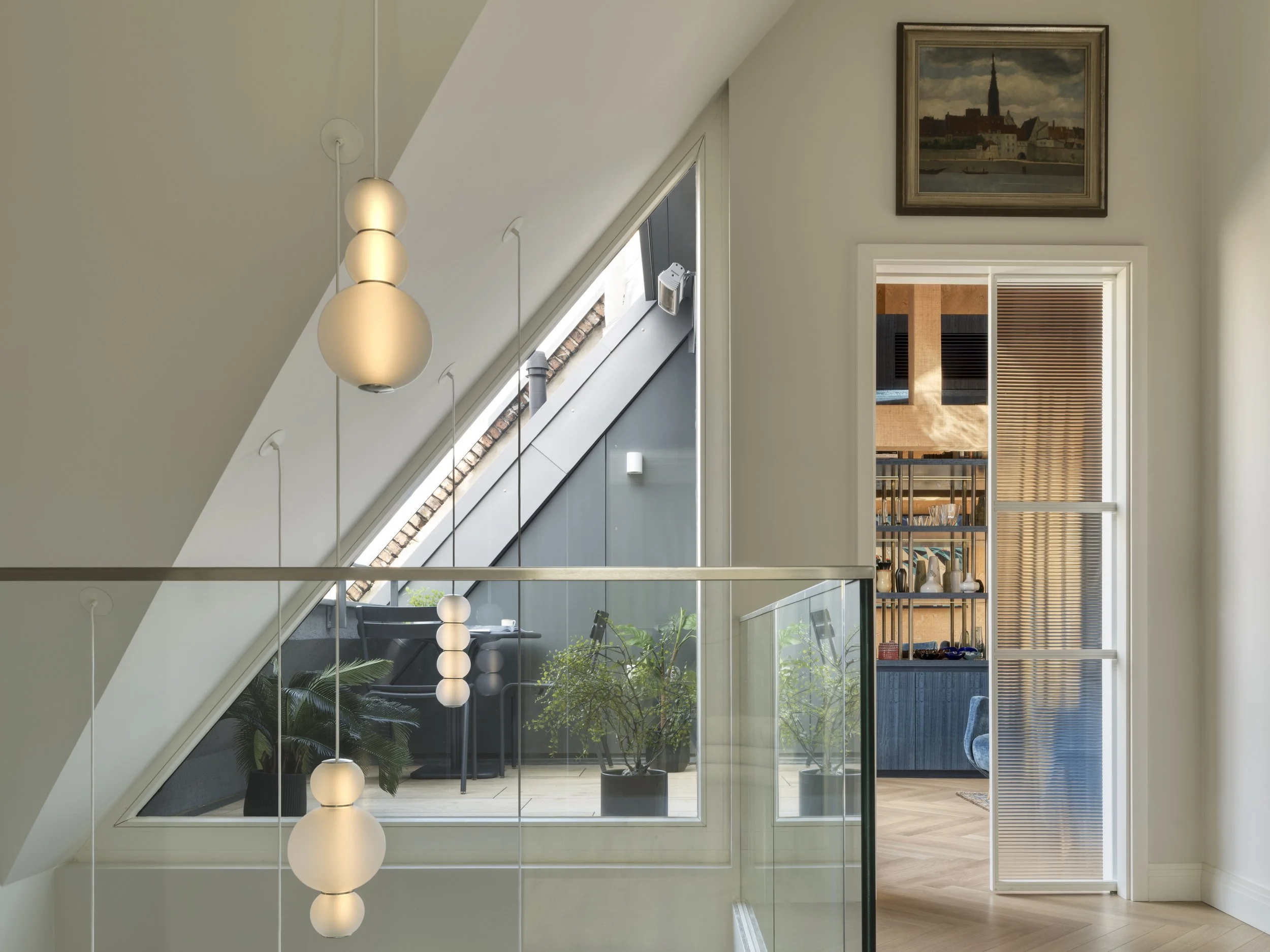
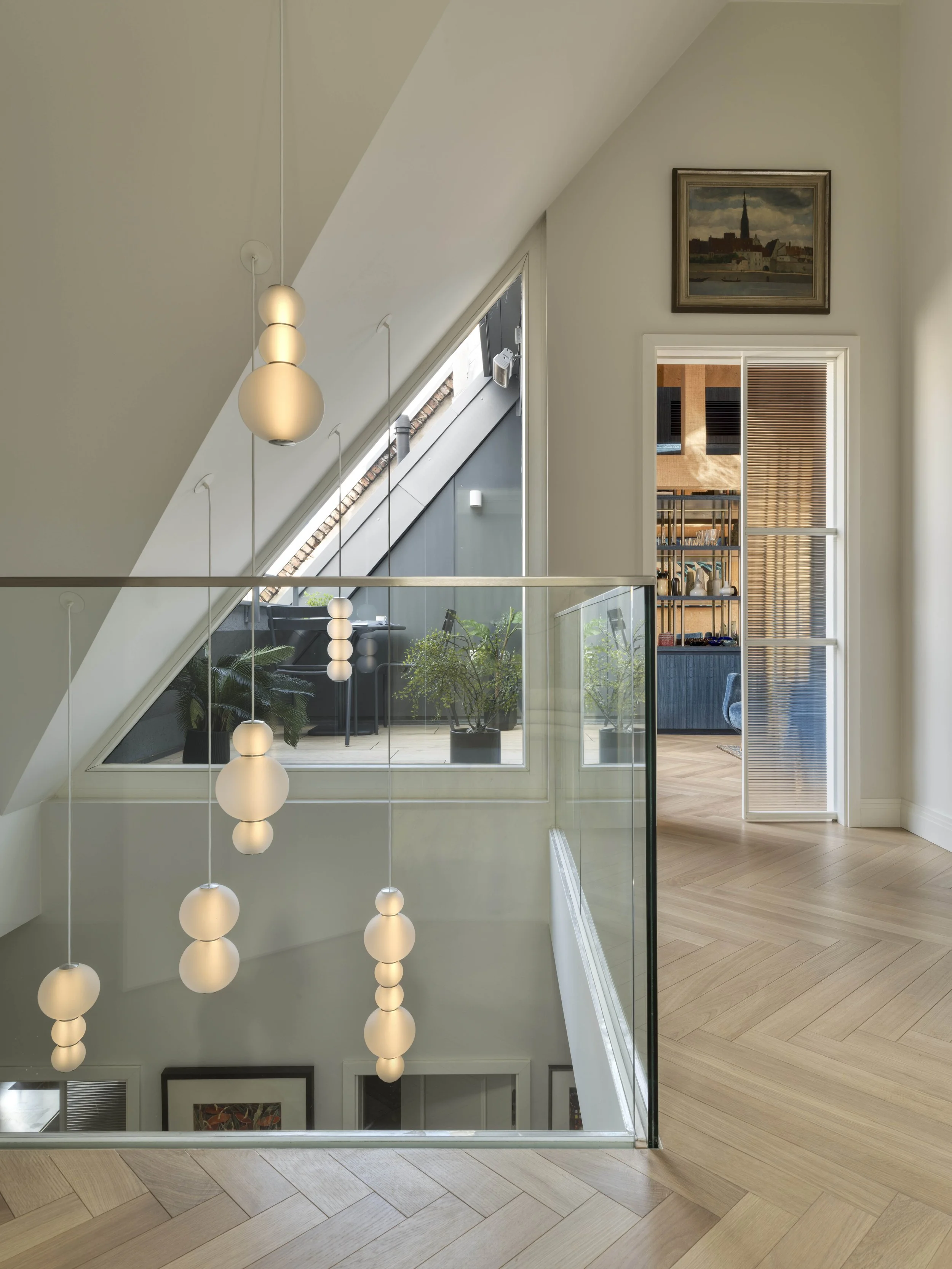
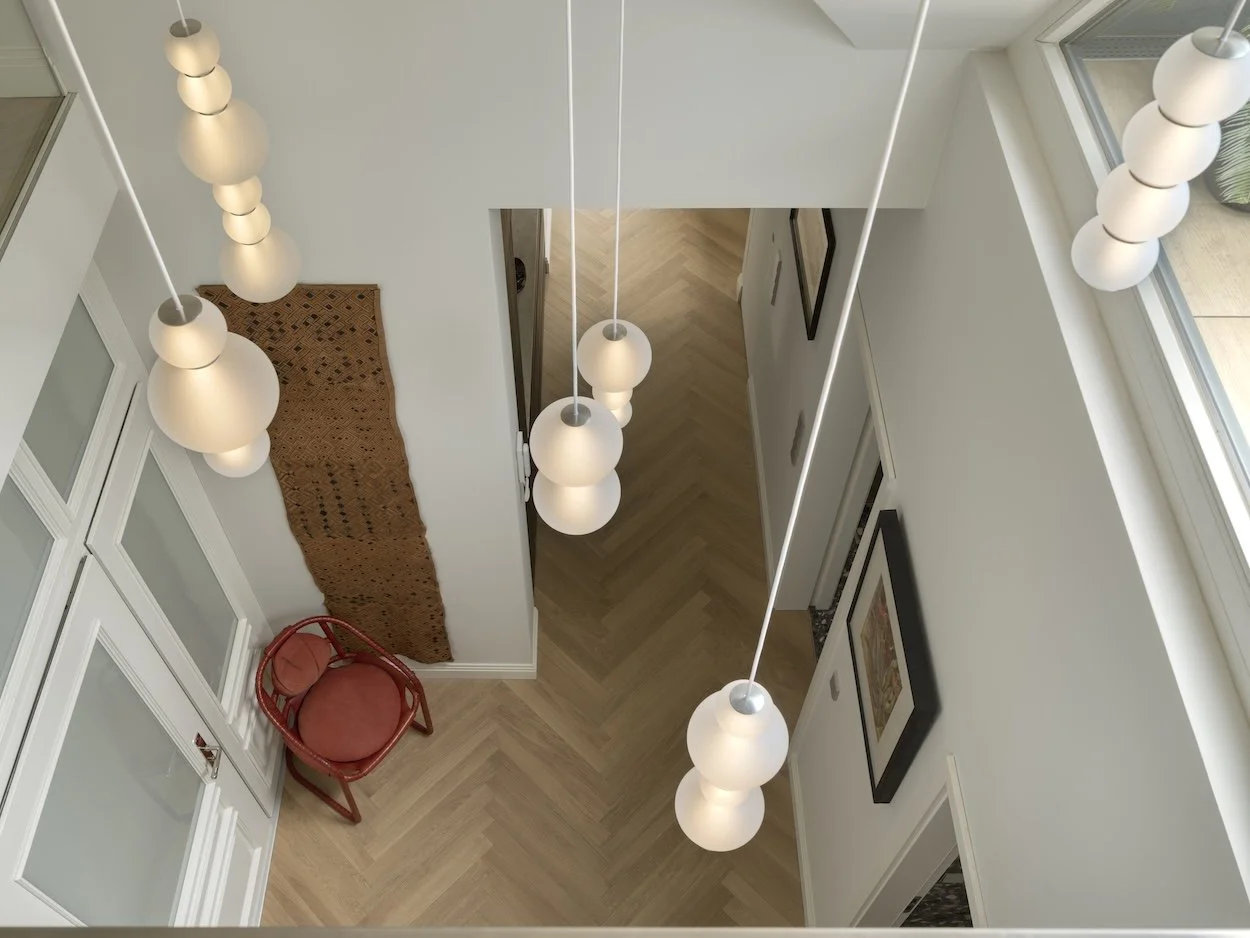
Above the staircase, we opened the ceiling into a double-height gallery, a five-metre volume of light that floods the entrance hall and connects both levels visually as well as physically. A glass balustrade keeps the space transparent and structurally resolved. A multi-pendant light by Formagenda, its seven pendants individually hung and arranged on the sloping roof, was modelled in 3D before installation to ensure the geometry was exact. It is the only piece of overt design in the gallery, and the piece that gives the volume its scale.
The dialogue between solid oak and floating glass, between sculpted form and architectural transparency, between the original masonry and the new addition, is where the project’s central question is answered most directly. Heritage and contemporary intervention do not need to look alike to belong together. They need to be honest about what they are.


UNDER THE ORIGINAL ROOF
The upper floor sits beneath the original roof of the building. The architecture is uncompromising: steep slopes, an existing chimney stack to work around, ceilings rising to four metres at their highest, and almost no straight walls to work with. Rather than fight the geometry, we designed the rooms around what the building gave us.
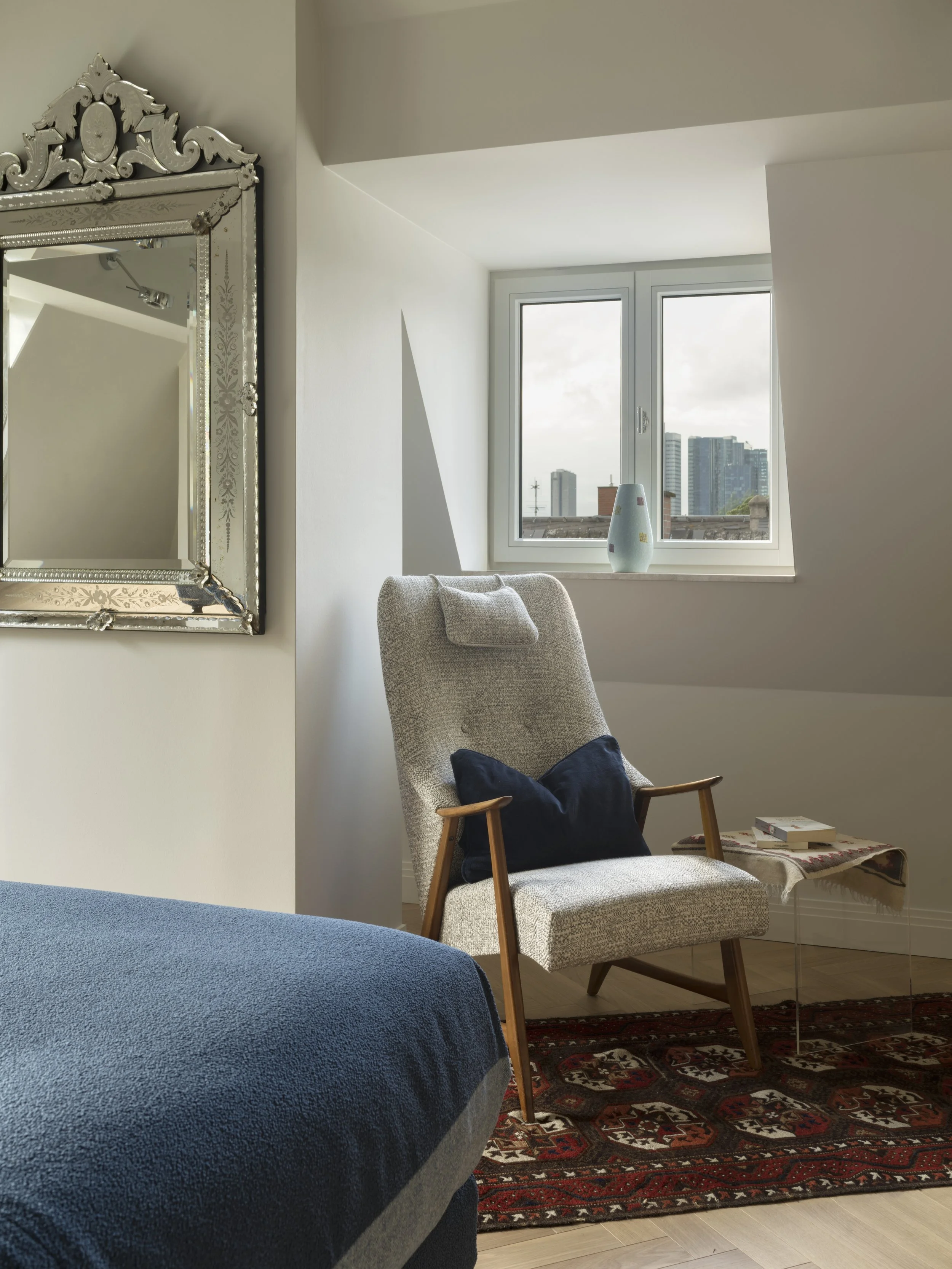
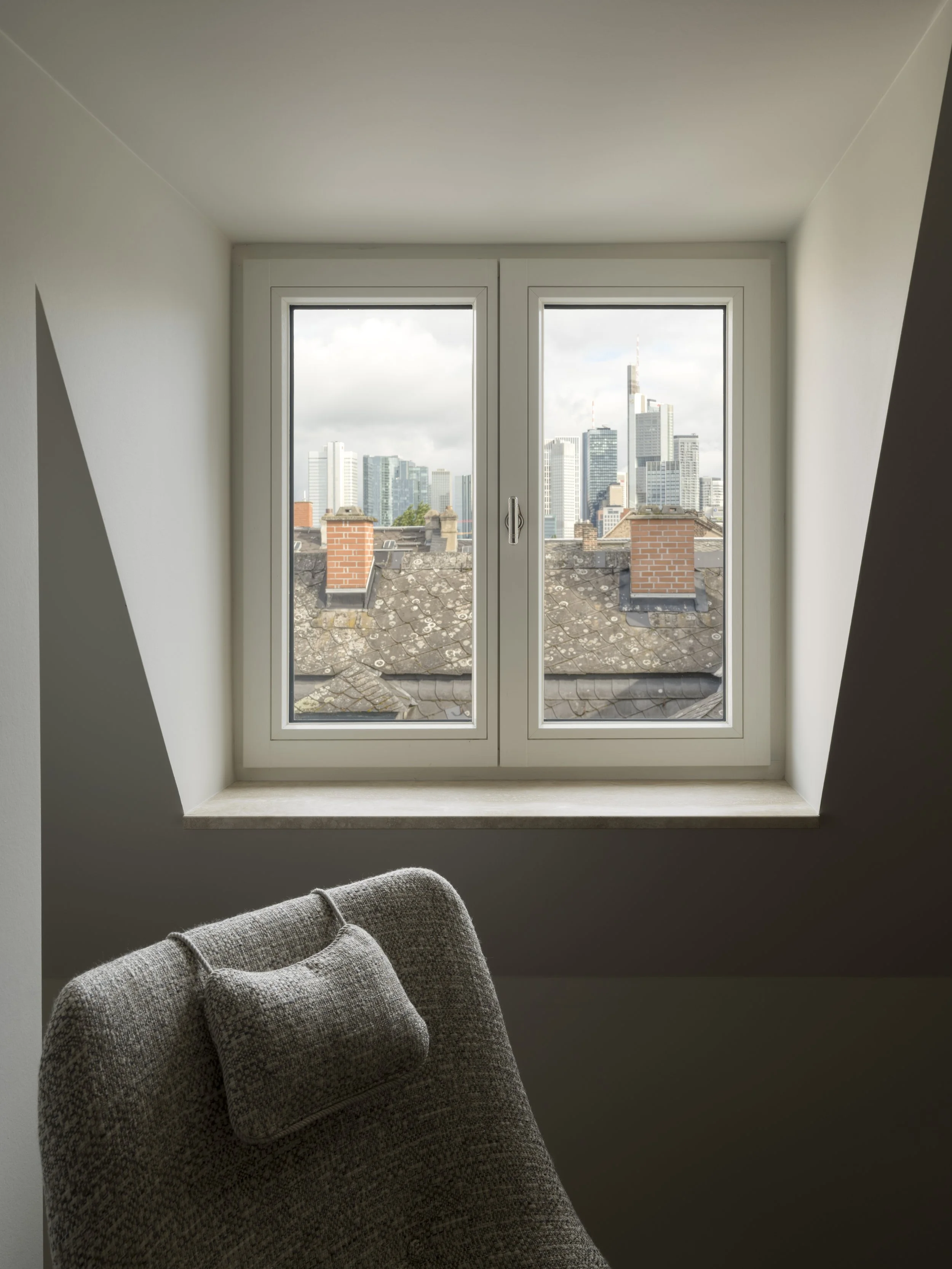
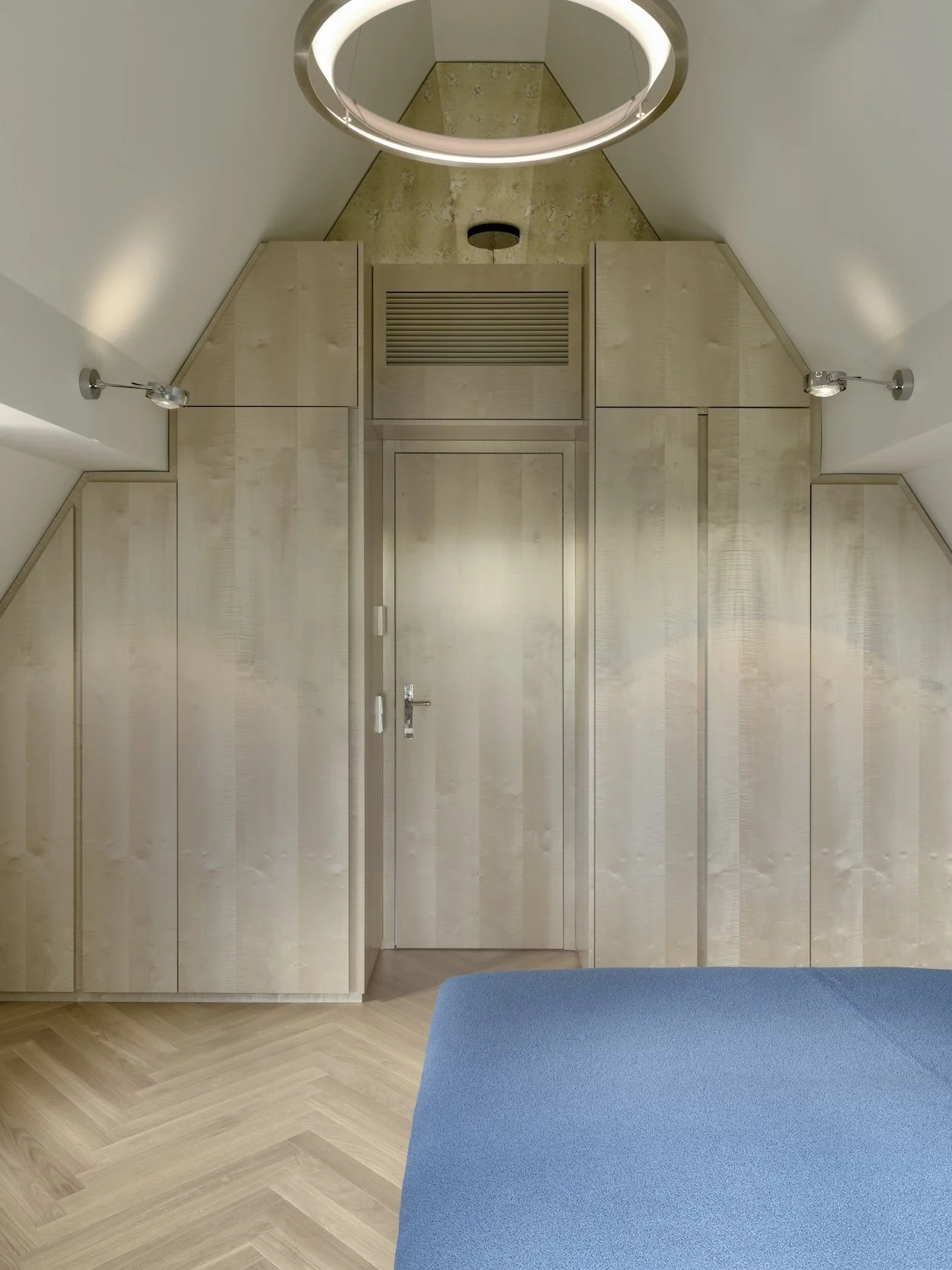
The master bedroom occupies the most demanding part of this geometry. Two kinds of window bring light in: a Velux set into the roofline to flood the room with daylight, and a dormer aligned precisely with Frankfurt’s skyline, where the view on clear days reaches as far as the Taunus mountains. The room’s only straight wall became the site for a bespoke wardrobe combining hanging space, shelving and pull-out drawers. The bed sits precisely beneath the slope, at the one point that allows full upright sitting against the headboard with the skyline in view. Behind it, a joinery headboard in eucalyptus veneer carries soft upholstery, built-in bedside tables, reading lights and concealed controls for the lighting and blinds. What could have been an awkward room is one whose constraints are exactly what give it character.
The study, on the same floor, has a steeply pitched ceiling that creates a strong sense of vertical space. We brought light in from both front and back to enhance the volume rather than fight it. A roof loggia was cut directly into the structure, a south-facing outdoor sitting area opening to skyline views over the city. Its floor is laid with outdoor wood-look tiles that match the interior oak: small, but enough for a table and chairs and a single sunlounger, with watering laid on for plants, an awning and a heater, so the space earns its keep year-round. Inside, the joinery is finished in blue eucalyptus veneer, detailed with brushed nickel rods, vintage mirror inlays and recessed LED lighting. A vintage desk and stool sit alongside contemporary lighting and bespoke joinery. In a less considered room the layering would feel staged. Here it feels precise.





THE FLOORplan REIMAGINED
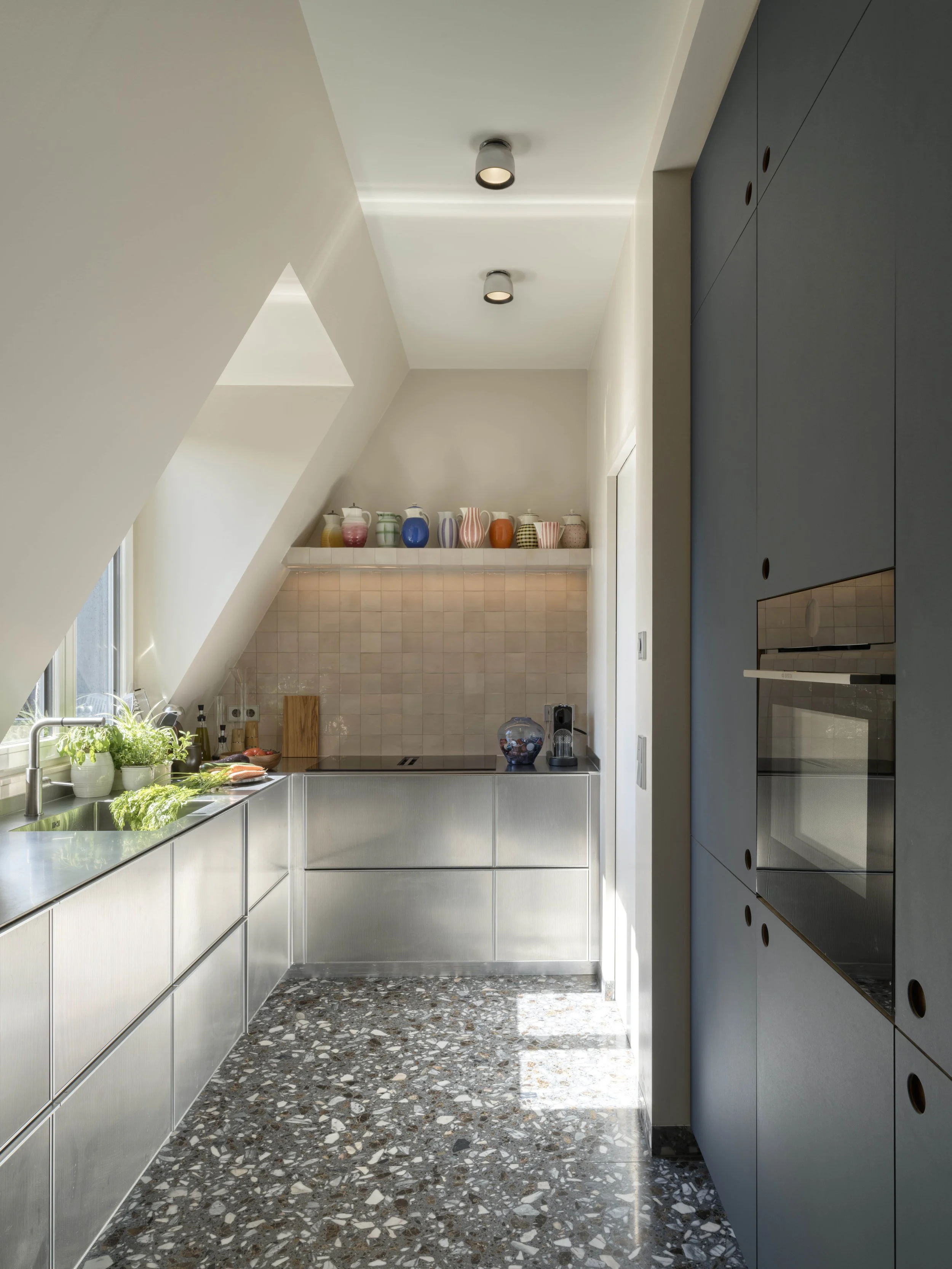
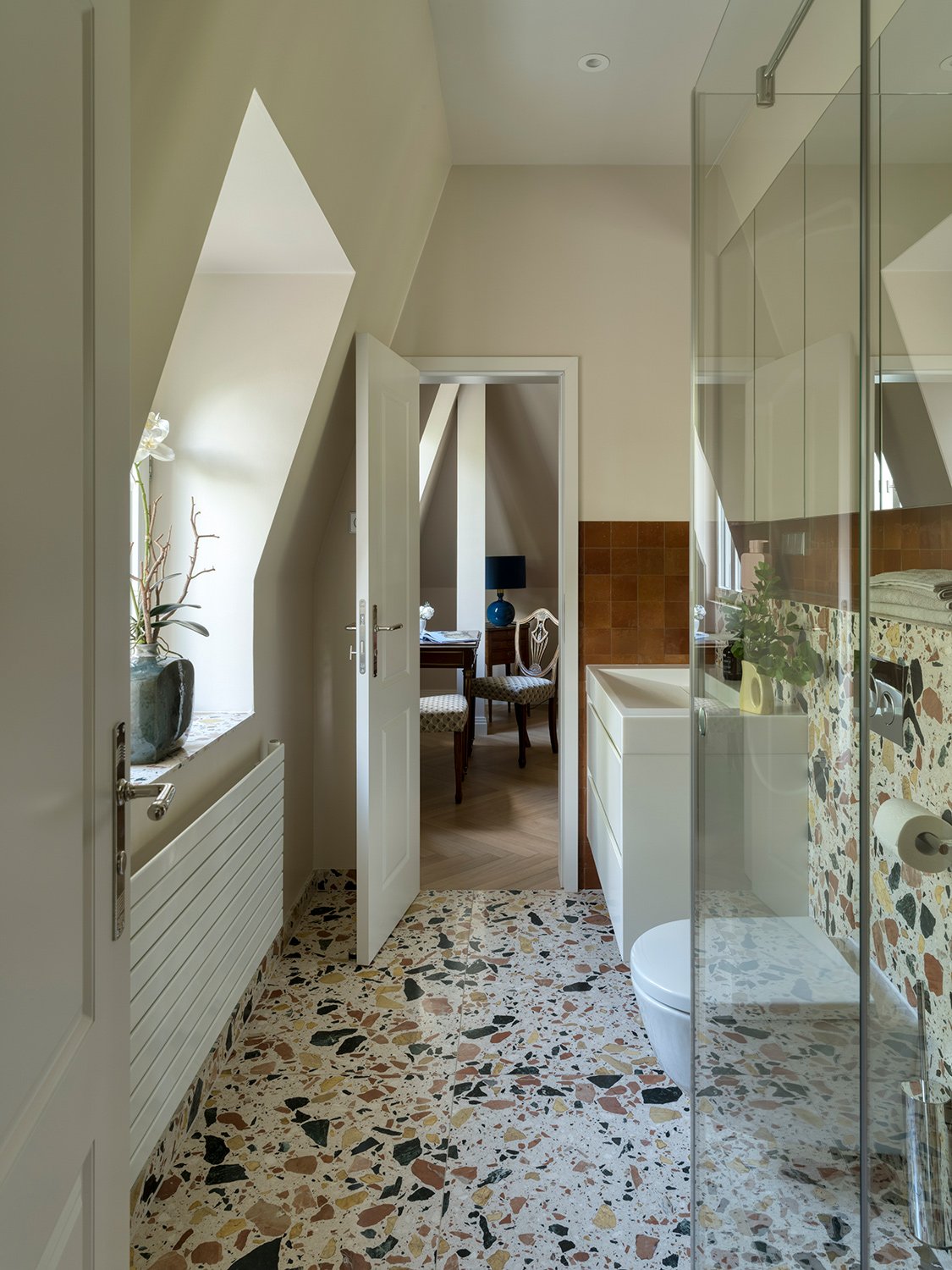
The original layout of the top-floor apartment was completely reconceived. The kitchen and bathroom were swapped. Internal walls were removed. The structure was stripped back to brick and beam, with steel supports introduced to open the spans and gain ceiling height, particularly where the rooflines begin to slope. Every dormer window was replaced and enlarged to bring more light through the floor.
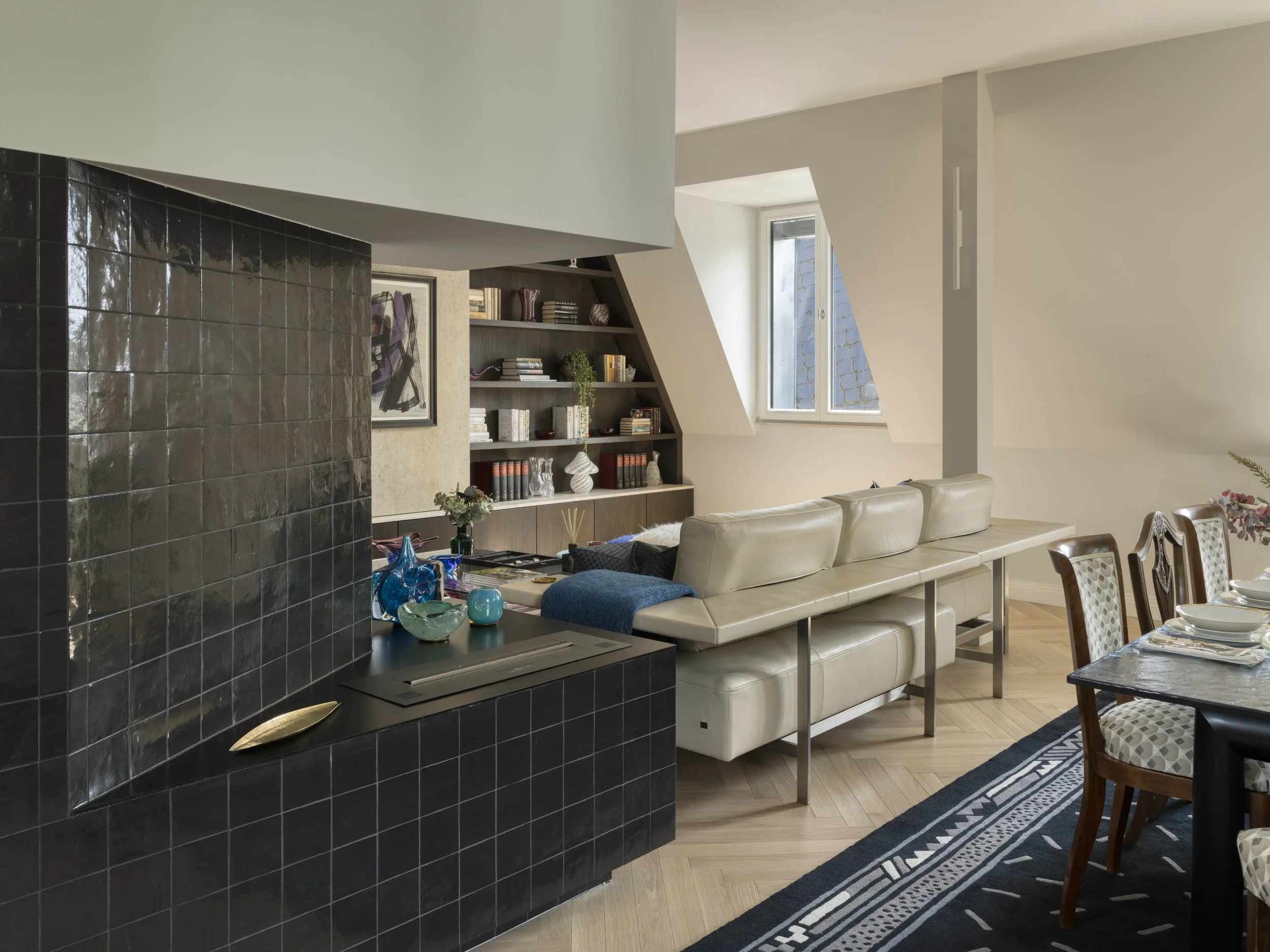
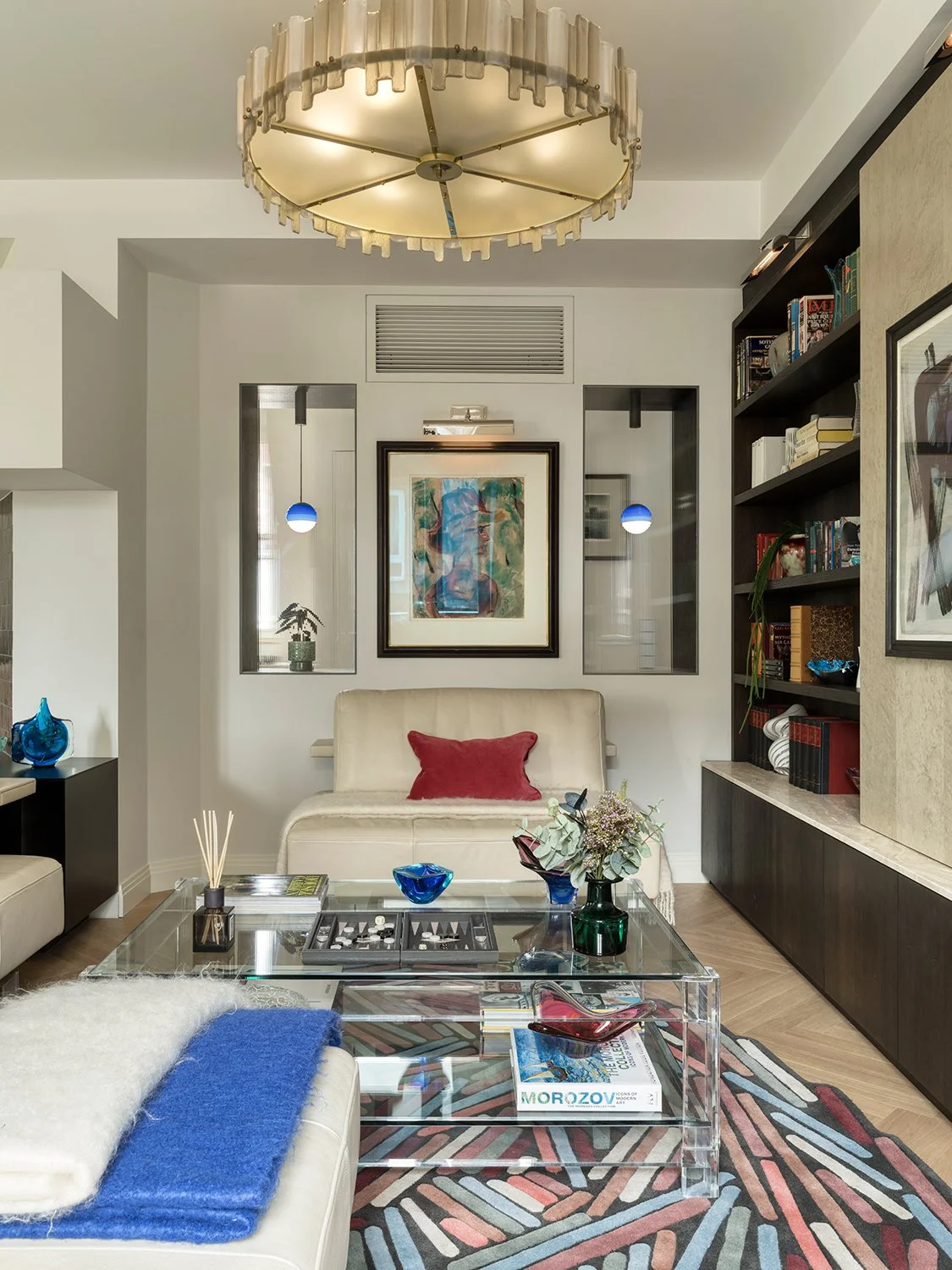
The result is an open-plan living, dining and kitchen space that feels generous from the moment of entry. To keep the volume open without letting it become undefined, we designed custom joinery and glass dividers around a central bioethanol fireplace. These create three subtle zones: a relaxed living area, a dining space, and a bar finished in the same ribbed stainless-steel fronts as the kitchen, tying the design together across the floor.
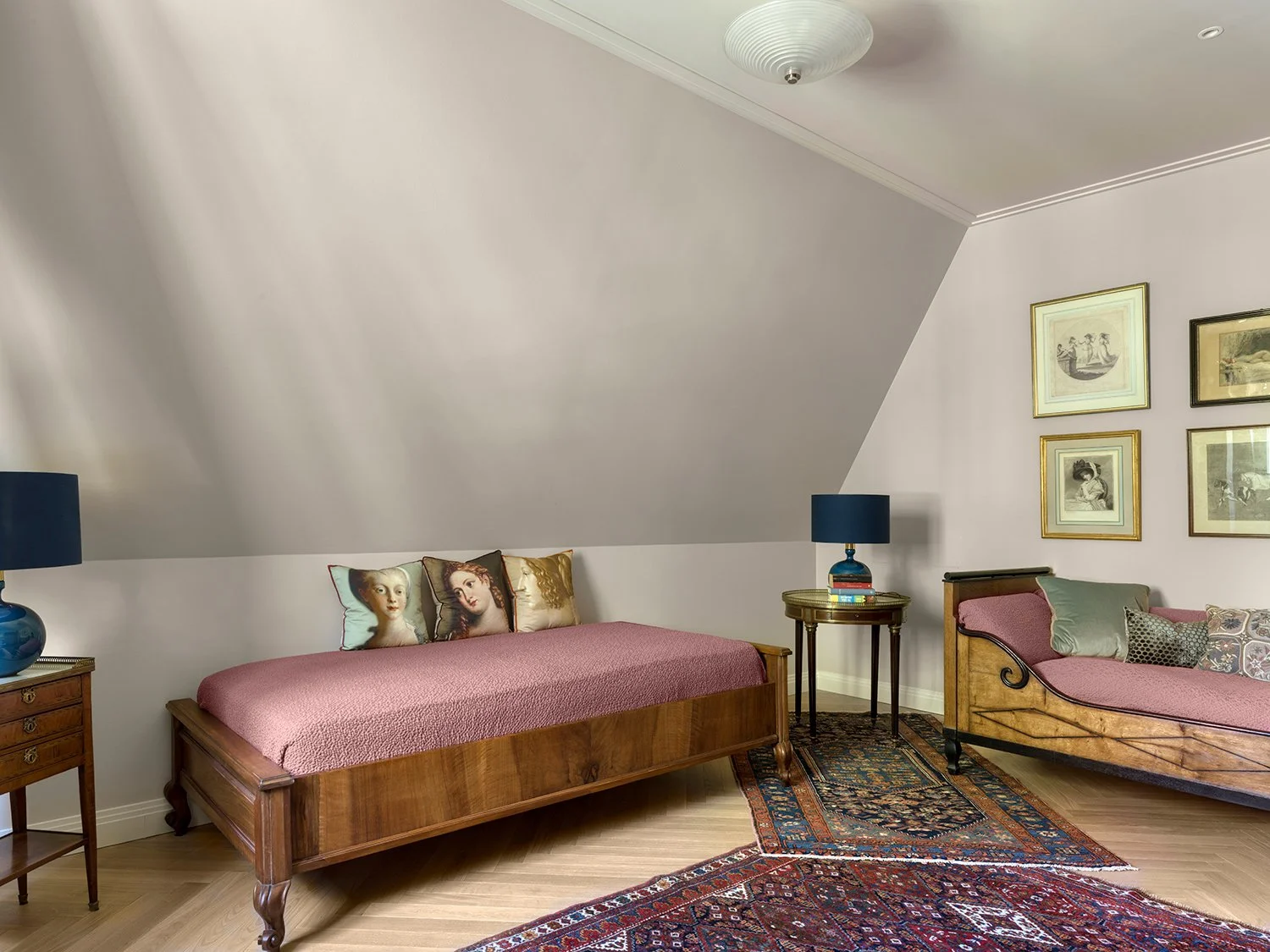
A feature bookcase runs the length of the main wall in dark-stained oak. A sliding panel in bird’s-eye maple conceals the television and frames a piece of modern art when closed. Stone surfaces, black Moroccan zellige tiles in the kitchen, and carefully chosen contemporary furniture complete a material palette that balances warmth, craft and contemporary precision. Two further bedrooms share a Jack-and-Jill bathroom, a layout that gives both rooms a sense of privacy while keeping the floor coherent.






THE NEXT CENTURY
Beneath every visible decision is an envelope rebuilt for the next century. The structure was stripped back to its brickwork. The original timber beams were exposed and replaced with steel where necessary. The entire envelope was rebuilt with new windows, doors, roof and heating system, and the home is powered by a dedicated photovoltaic system installed as part of the integrated work.
These are not the kinds of decisions most clients want to dwell on, and the finished penthouse rightly does not announce them. They sit beneath the surface: beneath the oak staircase, beneath the eucalyptus joinery, beneath the slate roof, making everything else possible. They are also what allow the home to do what the projects we are proudest of all do: to outlast trend, to age well, and to repay its initial care over decades rather than months. A century from now, the building will still be standing.





CITY
Urban Sophistication

Surf
Coastal Serenity

Ski
Alpine Craft
Every home begins with a conversation.
Every project begins with a conversation.
If you are considering a home and would like to talk through your ideas, we would be glad to hear from you.